















Localada’s free Florence audio guide covers 16 stops: 7 sights, 2 places to eat, 2 shops and 5 experiences, narrated in 15 languages. Seeing all 7 sights takes roughly 10.5–13.5 hours of visiting time, before travel between them. 12 of the 16 stops come with a Localada perk, such as 5% off GetYourGuide tickets or a discount at a verified local restaurant or shop.
Opening hours, perks and visit times below come from the live Localada app and were last checked on 29 October 2026. Always confirm on the day: hours can change for holidays and prayer times.
Open the free Florence guide →
Florence audio guide stops at a glance
| # | Stop | Type | Time to allow | Hours | Closed | Today | Nearest transport | Localada perk |
|---|---|---|---|---|---|---|---|---|
| 1 | The Duomo & Brunelleschi's Dome | Cathedral | 2 hours | 10:15–16:30 | Sunday | — | Duomo · C2 · at the square | 5% OFF |
| 2 | The Uffizi Gallery | Museum | 2–3 hours | 08:15–18:30 | Monday | — | Piazza della Signoria · C1 · 3 min walk | 5% OFF |
| 3 | The Accademia & Michelangelo's David | Museum | 1–1.5 hours | 08:15–18:50 | Monday | — | San Marco · C1 · 4 min walk | 5% OFF |
| 4 | Palazzo Vecchio & the Secret Passages | Palace | 1.5 hours | 09:00–19:00 | — | — | Piazza della Signoria · C1 · at the square | 5% OFF |
| 5 | The Pitti Palace & the Boboli Gardens | Palace | 2–3 hours | 08:15–18:30 | Monday | — | Pitti · C3 · at the square | 5% OFF |
| 6 | The Medici Chapels & San Lorenzo | Chapel | 1 hour | 08:15–18:50 | Sunday | — | San Lorenzo · C1 · 3 min walk | 5% OFF |
| 7 | The Bargello | Museum | 1–1.5 hours | 08:15–14:00 | Sunday | — | Piazza della Signoria · C1 · 4 min walk | 5% OFF |
| 8 | Fresh Pasta Class with Unlimited Wine | Cooking class | 3 hours | 10:00–21:00 | — | — | San Lorenzo · C1 · 3 min walk | 5% OFF |
| 9 | The Perfume Masterclass | Workshop | 2 hours | 10:00–19:00 | Sunday | — | Santa Maria Novella · T1 · 6 min walk | 5% OFF |
| 10 | Pizza & Gelato Making Class | Cooking class | 3 hours | 10:00–22:00 | — | — | Pitti · C3 · 6 min walk | 5% OFF |
| 11 | Florentine Steak & Wine Food Walk | Food tour | 3–4 hours | 10:00–21:00 | Sunday | — | San Lorenzo · C1 · 2 min walk | 5% OFF |
| 12 | Paint & Wine over the Ponte Vecchio | Workshop | 2 hours | 10:00–20:00 | — | — | Ponte Vecchio · C3 · 4 min walk | 5% OFF |
| 13 | Trattoria Sostanza | Trattoria | — | 12:00–22:00 | Saturday, Sunday | — | Santa Maria Novella · T1 · 7 min walk | — |
| 14 | Il Santo Bevitore | Restaurant | — | 12:30–23:00 | — | — | Santo Spirito · C3 · 5 min walk | — |
| 15 | Scuola del Cuoio | Shop | — | 10:00–18:00 | Sunday | — | Santa Croce · C2 · 4 min walk | — |
| 16 | Officina Profumo-Farmaceutica di Santa Maria Novella | Shop | — | 09:30–20:00 | — | — | Santa Maria Novella · T1 · 5 min walk | — |
How much time do you need in Florence?
- Highlights only (about 5–6.5 hours): The Duomo & Brunelleschi's Dome, The Uffizi Gallery and The Accademia & Michelangelo's David.
- Every sight in the guide (about 10.5–13.5 hours): all 7 sights in route order; split across 2 days at a comfortable pace.
- Add food, shopping and experiences: 9 more stops, from verified restaurants to workshops and shows, listed below.
Sights in the Florence audio guide
The Duomo & Brunelleschi's Dome
Full The Duomo & Brunelleschi's Dome audio guide →
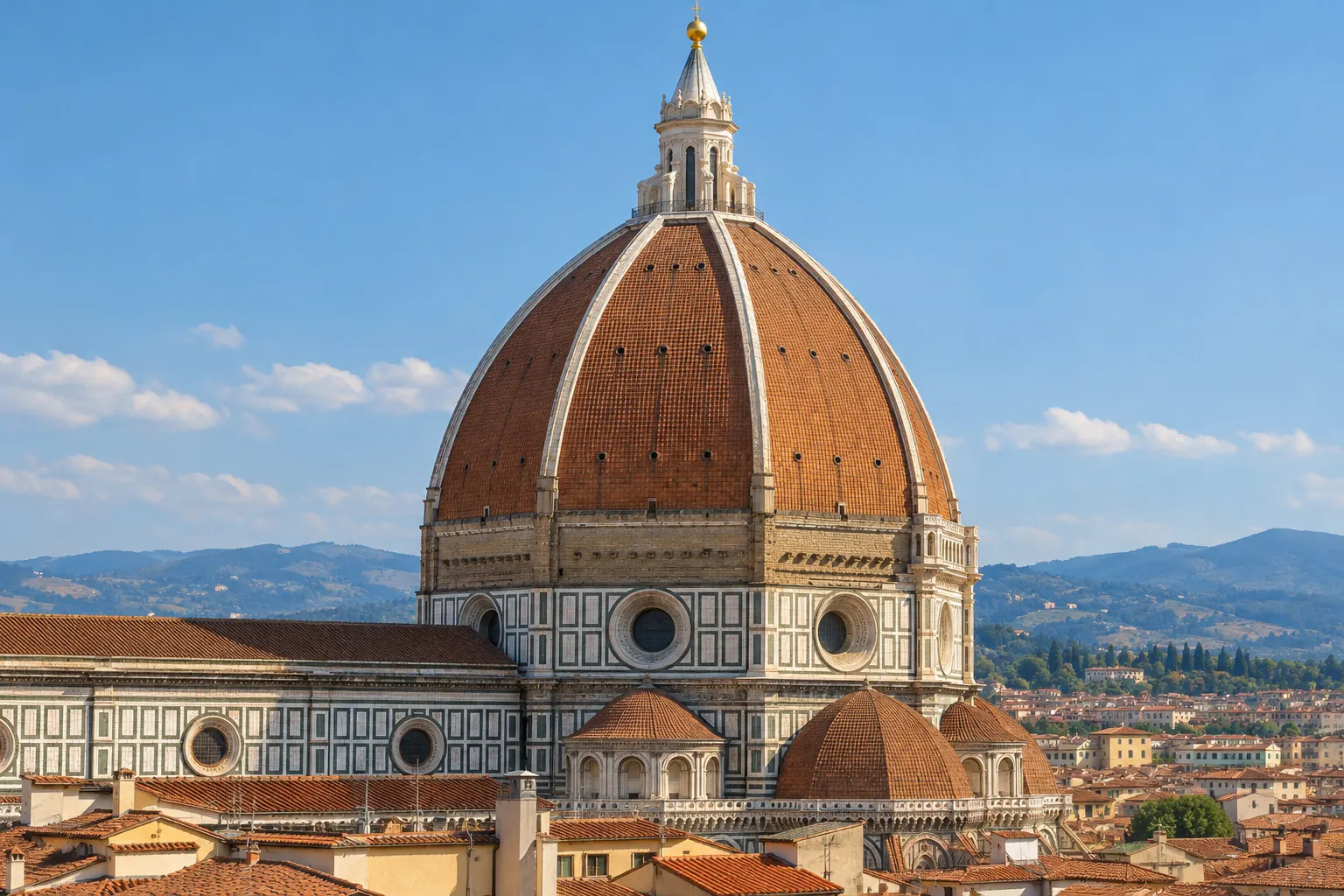
They put up the cathedral with a hole in the roof and left it that way for over a century.
The plan called for a dome a hundred and forty-three feet across, wider than anything built since antiquity, and nobody in 1296 knew how. Vaults that size needed wooden centring to hold them while the mortar set, and there was not enough timber in Tuscany. So the walls went up, the crossing was left open to the sky, and Florence waited.
Filippo Brunelleschi won the commission in 1418 with a proposal he refused to explain, apparently because he was afraid of being copied. He built it with no centring at all — two shells, one inside the other, four million bricks laid in a herringbone pattern that locked each course in place as it went up. The pattern is the trick. Each ring supports itself as it closes.
- Time to allow: 2 hours
- Hours: 10:15–16:30 (closed Sunday)
- Address: Piazza del Duomo, 50122 Florence
- Nearest transport: Duomo · C2 · at the square (C1 · C2)
- Localada perk: 5% OFF – Dome climb and Duomo entry — book below
- The dome climb is 463 steps, one-way, no lift, with tight passages near the top — not for anyone claustrophobic. Climbs are timed and must be reserved. The cathedral, baptistery, bell tower and museum are separate entries on the combined pass.
Local tips
- Reserve the dome slot before you arrive — they sell out days ahead in season.
- Giotto's bell tower across the square is a shorter climb and gives you the dome in the view.
- The baptistery doors you see outside are copies; the originals are in the museum behind the cathedral.
- Enter the cathedral itself early; the nave queue is separate from the dome queue.
- Look up inside the dome for Vasari's Last Judgement — it covers 3,600 square metres.
The Uffizi Gallery
Full The Uffizi Gallery audio guide →
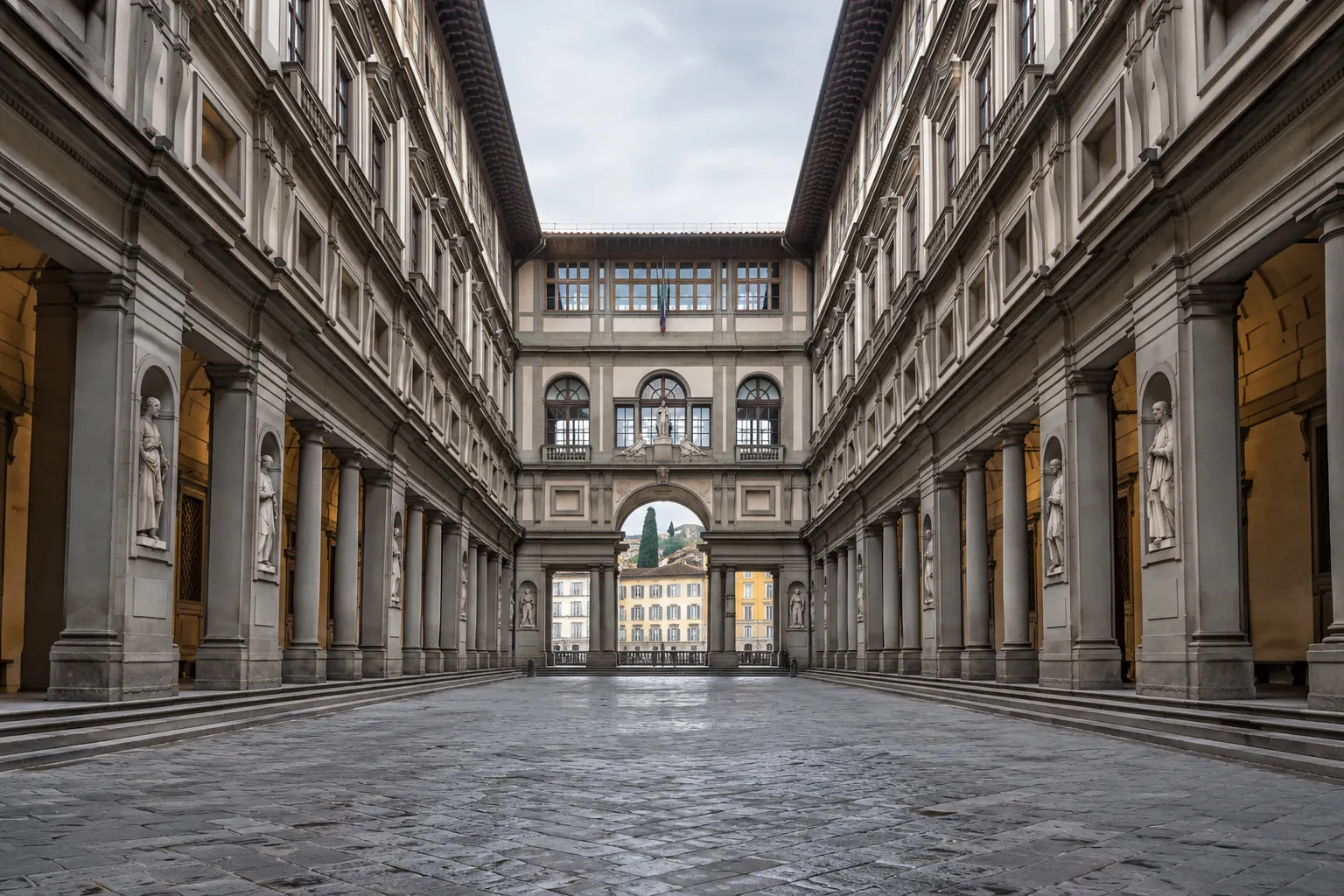
Uffizi means offices. That is literally what this was.
Cosimo I de' Medici wanted the city's magistrates under one roof where he could keep an eye on them, so in 1560 he had Vasari build a long U of administrative rooms running down to the river. The family started hanging their art in the top-floor corridor. Visitors had to ask permission to see it. By 1765 it was open to anyone, which makes it one of the first public museums in Europe.
What hangs here is not a collection of Renaissance paintings. It is the collection — Botticelli's Birth of Venus and Primavera in the same room, Leonardo's Annunciation, Michelangelo's only finished panel painting, Caravaggio's Medusa on a shield.
- Time to allow: 2–3 hours
- Hours: 08:15–18:30 (closed Monday)
- Address: Piazzale degli Uffizi 6, 50122 Florence
- Nearest transport: Piazza della Signoria · C1 · 3 min walk (C1 · C2)
- Localada perk: 5% OFF – Small group guided tour of the Uffizi — book below
- Timed entry; the route runs one way through two floors and takes most people two to three hours. Large bags go in the cloakroom. Photography without flash is allowed in most rooms. Closed Mondays. The Vasari Corridor is a separate ticket.
Local tips
- Book a timed slot — walk-up queues here run to two hours in season.
- The Botticelli room fills first; go there before anything else, then double back.
- The corridor windows over the Arno are the best view in the building and nobody stops at them.
- The rooftop café terrace looks straight at Palazzo Vecchio.
- Closed Mondays, which catches a lot of people out.
The Accademia & Michelangelo's David
Full The Accademia & Michelangelo's David audio guide →
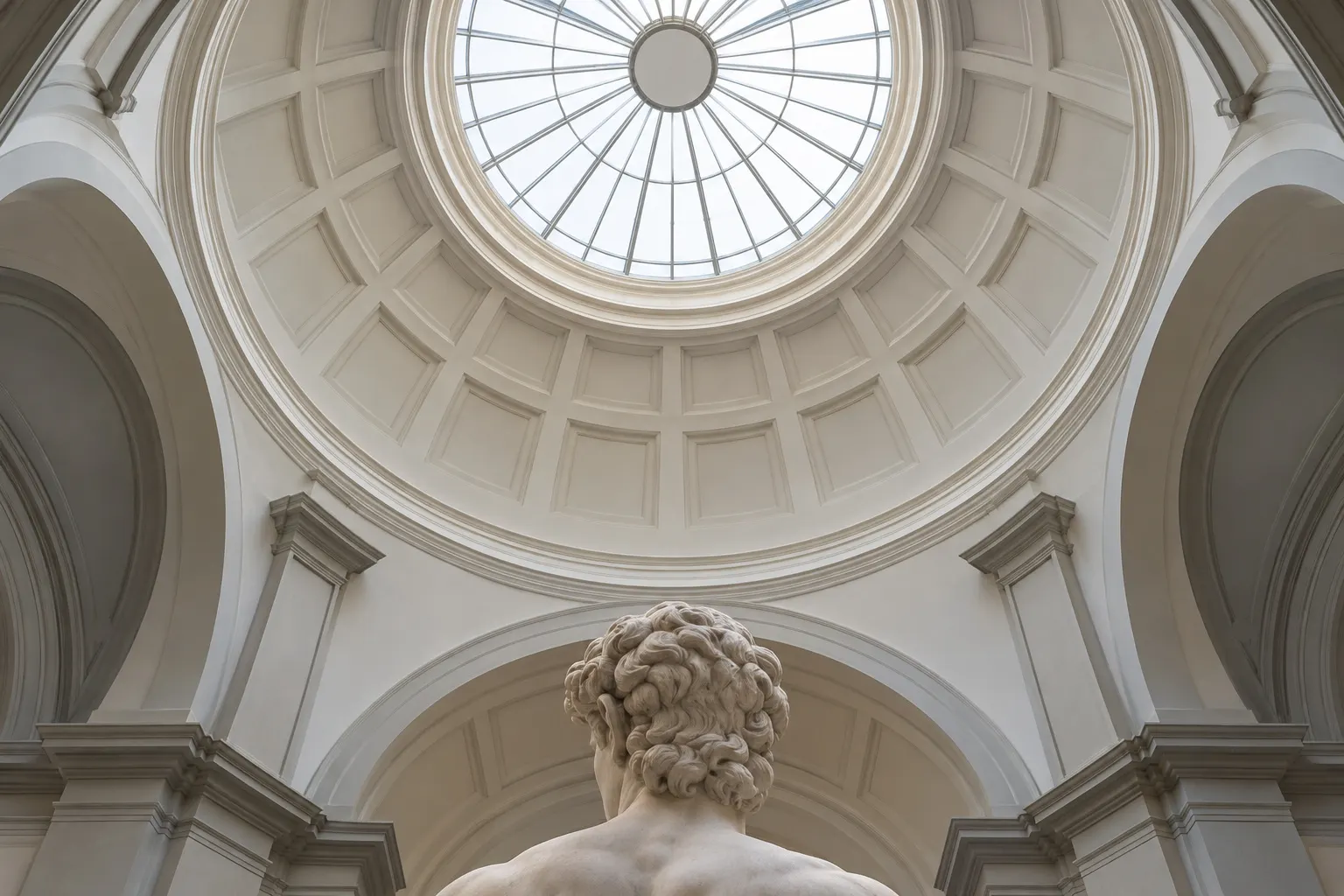
The marble had been sitting in a cathedral yard for forty years when Michelangelo got it.
Two sculptors had already tried. One cut a rough channel between what would become the legs and abandoned it; the block was declared ruined, too tall and too narrow to be useful. It was known around Florence as the Giant. Michelangelo was twenty-six when he asked for it.
He worked for two years behind a wooden screen and let nobody in. When it came out in 1504 a committee including Leonardo da Vinci argued for weeks about where to put it, and it took forty men four days to move it half a kilometre to the Piazza della Signoria.
Stand to the left and look at the right hand. It is out of proportion, deliberately — the hand of a man about to do something, swollen with blood, veins up. The sling is over the shoulder and the stone is in it. This is the moment before, not after.
- Time to allow: 1–1.5 hours
- Hours: 08:15–18:50 (closed Monday)
- Address: Via Ricasoli 58/60, 50122 Florence
- Nearest transport: San Marco · C1 · 4 min walk (C1)
- Localada perk: 5% OFF – Timed entry to Michelangelo's David — book below
- Small museum built around one sculpture; most people are done in an hour. Timed entry and booking are effectively required. Closed Mondays. The unfinished Prisoners line the hall leading up to the David and are easy to walk straight past.
Local tips
- Book a slot — the unbooked queue here is the worst in the city.
- First entry of the morning gives you the hall almost empty.
- Stop at the Prisoners on the way in; the figures half-out of the stone are the point of the room.
- Walk round the David fully; the back is rarely photographed and shows the tool marks.
- An hour is genuinely enough here — do not over-plan it.
Palazzo Vecchio & the Secret Passages
Full Palazzo Vecchio & the Secret Passages audio guide →

The building has a second building inside it.
Florence has governed itself from this fortress since 1299, and when the Medici moved in they did what ruling families do: they built ways of moving around that nobody else could see. A staircase runs inside the thickness of a wall. A study the size of a wardrobe, the Studiolo, has no windows and panels that open — Francesco I kept his experiments and his collection in there and could reach it without crossing a public room.
Above the Hall of the Five Hundred there is a gap between the painted ceiling and the roof beams, and you can walk through it on a catwalk looking down at the back of Vasari's frescoes.
- Time to allow: 1.5 hours
- Hours: 09:00–19:00 (open daily)
- Address: Piazza della Signoria, 50122 Florence
- Nearest transport: Piazza della Signoria · C1 · at the square (C1 · C2)
- Localada perk: 5% OFF – Skip-the-line entry and secret passage tour — book below
- The secret passages, the Studiolo and the roof catwalk are a guided visit on a separate timed ticket from the museum rooms. The tower climb is another ticket again and closes in bad weather. Narrow stairs throughout.
Local tips
- The secret passage tour is the reason to come; book it rather than the plain museum ticket.
- The Hall of the Five Hundred can be seen from the courtyard — look up even if you go no further.
- Find the cerca trova pennant high on the right-hand fresco.
- The tower and the museum are sold separately; the tower view includes the Duomo.
- The copy of the David outside stands where the original stood until 1873.
The Pitti Palace & the Boboli Gardens

Luca Pitti was a rival banker, and the story Florence tells is that he wanted windows larger than the Medici doorway.
He went bankrupt before it was finished. A century later the Medici bought the shell, moved in, and spent two hundred years making it four times bigger. Then the kings of Italy used it. Then it became a museum, and the paintings hang the way the Medici hung them — frames touching, three rows high, Raphael next to Rubens with no explanatory label in sight. It is the opposite of a modern gallery and it is worth seeing for that alone.
Behind the palace the hill rises into the Boboli, which invented the Italian garden as an idea — terraces, long axes, an amphitheatre cut into the slope with an Egyptian obelisk at the centre. Half the statues are Roman originals. Nobody agrees how the Medici got them all.
- Time to allow: 2–3 hours
- Hours: 08:15–18:30 (closed Monday)
- Address: Piazza de’ Pitti 1, 50125 Florence
- Nearest transport: Pitti · C3 · at the square (C3 · D)
- Localada perk: 5% OFF – Pitti Palace, Boboli and Palatine Gallery tour — book below
- The palace holds several separate museums on one combined ticket; the Palatine Gallery is the main one. The gardens are a steep hillside with gravel paths and limited shade. Closed Mondays. The garden is a separate entry from the galleries.
Local tips
- Do the Palatine Gallery first, then the garden — the climb is easier before the rooms than after.
- The amphitheatre behind the palace is the best photograph and most people walk past it.
- The Porcelain Museum at the top of the hill has the view and no crowd.
- The Vasari Corridor arrives here from the Uffizi; look for the door it comes through.
- Summer afternoons on the hill are punishing; go in the morning.
The Medici Chapels & San Lorenzo
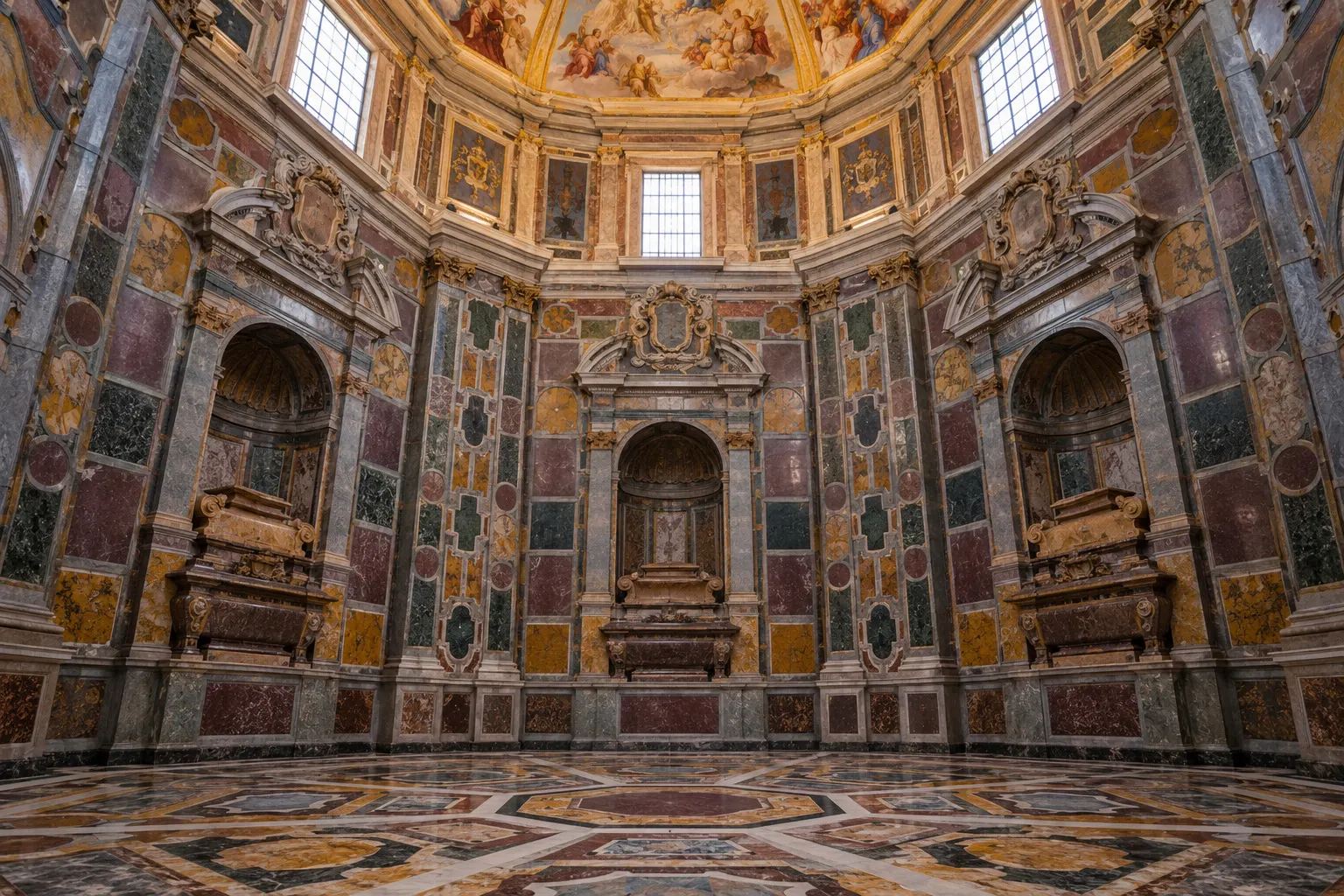
The family that ran Florence for three centuries is buried behind their parish church.
San Lorenzo was the Medici church, and the chapels attached to it were built to hold them. The Chapel of the Princes is the loud one — an octagon lined floor to dome in inlaid semi-precious stone, porphyry and jasper and lapis, worked by a dedicated workshop that took almost three hundred years to finish it. It is extraordinary and slightly oppressive.
The New Sacristy next door is Michelangelo's, and it is the opposite. Two tombs, four reclining figures: Dawn and Dusk on one, Night and Day on the other. The commission was for a much bigger scheme and he left Florence before completing it. Several figures are unfinished and the room is better for it — you can see the chisel stopping.
- Time to allow: 1 hour
- Hours: 08:15–18:50 (closed Sunday)
- Address: Piazza di Madonna degli Aldobrandini 6, 50123 Florence
- Nearest transport: San Lorenzo · C1 · 3 min walk (C1 · C2)
- Localada perk: 5% OFF – Reserved entrance to the Medici Chapels — book below
- The Medici Chapels and the Basilica of San Lorenzo are separate tickets with separate entrances on opposite sides of the block. Closed on some Mondays and Sundays — the rota changes. The Laurentian Library has its own hours again.
Local tips
- The chapels entrance is round the back on Piazza Madonna degli Aldobrandini, not through the church.
- Give the New Sacristy more time than the Chapel of the Princes — it is the smaller and better room.
- The unfinished faces are deliberate to look at; stand close.
- The market street outside is the leather stalls; prices there are negotiable and quality varies.
- Check the closing rota before you come; it is irregular.
The Bargello
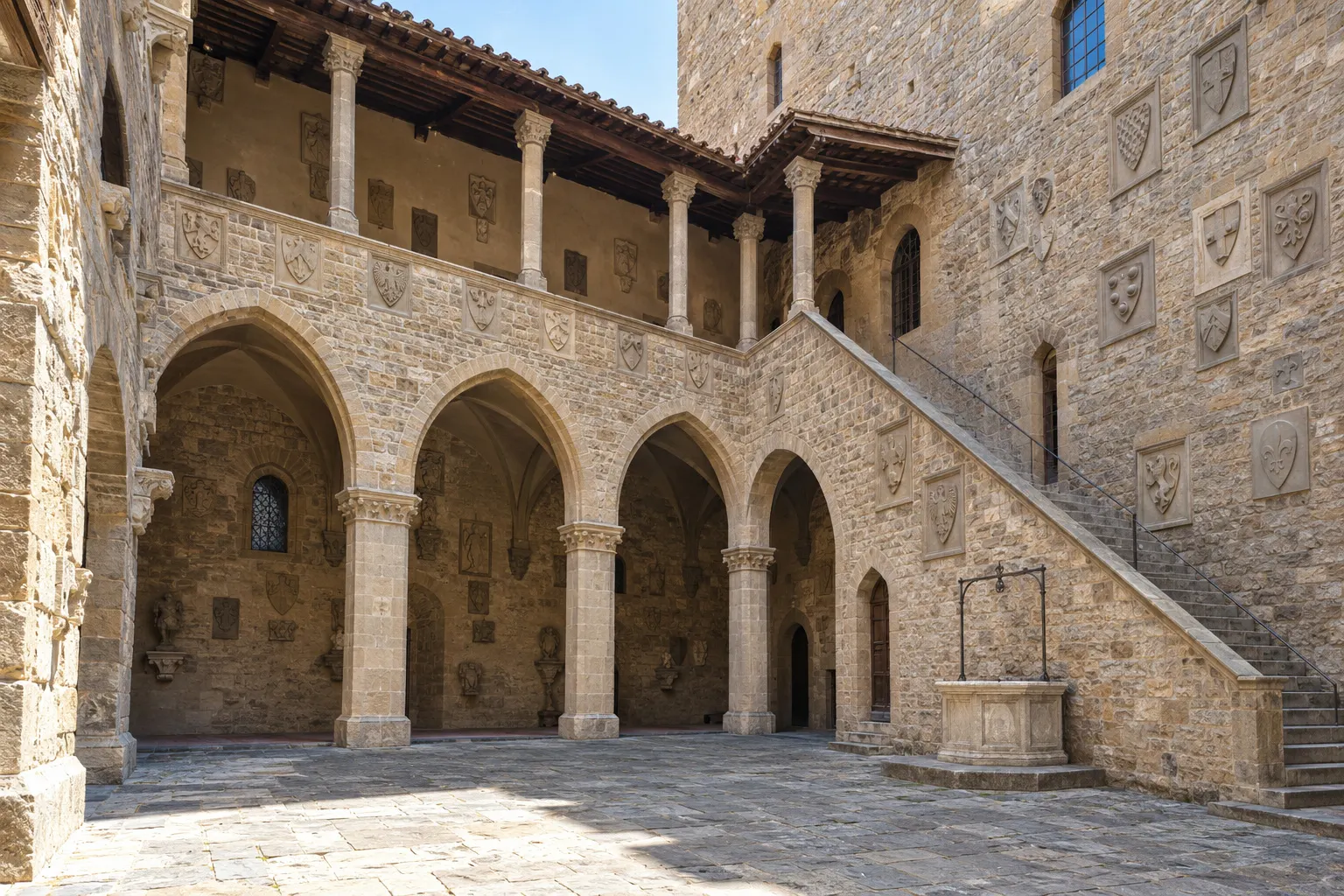
This was a prison, and before that the police barracks. Executions happened in the courtyard. The word bargello meant the chief of police.
It is now the sculpture museum, and it holds the pieces the painting galleries do not: Donatello's bronze David, Verrocchio's, Michelangelo's drunken Bacchus, the two competition panels that started the Renaissance argument.
Donatello's David is the one to walk around. Cast about 1440, it was the first free-standing nude bronze made in Europe since antiquity, and it does not look like a hero. The boy is slight, almost smirking, wearing nothing but boots and a shepherd's hat with laurel on it. Goliath's severed head is under his foot and one of the giant's helmet feathers runs up the inside of the boy's leg. Scholars have been arguing about that detail for a hundred years.
- Time to allow: 1–1.5 hours
- Hours: 08:15–14:00 (closed Sunday)
- Address: Via del Proconsolo 4, 50122 Florence
- Nearest transport: Piazza della Signoria · C1 · 4 min walk (C1 · C2)
- Localada perk: 5% OFF – Reserved entry ticket to the Bargello — book below
- Three floors around an open courtyard; the stairs are the only way up. Quiet even in high season. Closed on alternating Mondays and some Sundays — the rota is irregular. Bags go in lockers at the entrance.
Local tips
- Ten minutes from the Uffizi and a fraction of the crowd — come here when the queues defeat you.
- The two 1401 competition panels are on the first floor; compare them side by side.
- Walk fully around Donatello's David, including the back.
- The courtyard has the old prison coats of arms set into the walls.
- Check opening days before setting out; the rota changes month to month.
Where to eat: verified local picks
Trattoria Sostanza
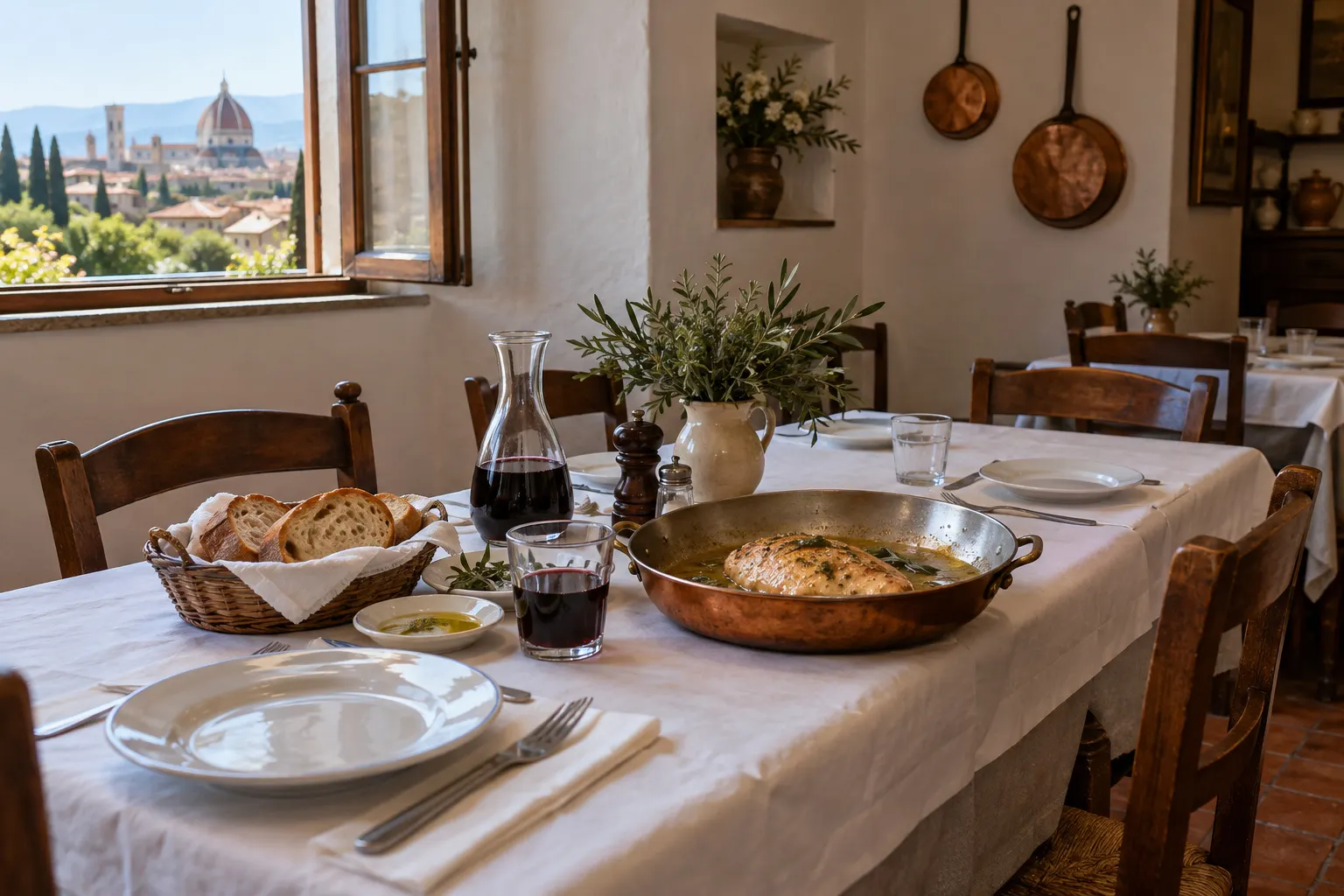
Open since 1869 and known to everyone in Florence by its nickname, Il Troia — the trough — because of the way people used to crowd in and eat.
It is one long room with marble-topped tables, paper cloths, a tiled wall and an open kitchen at the back with a coal-fired range. You sit where you are put, often with strangers. There are about ten things on the menu and most of them have not changed in a century.
The dish is petto di pollo al burro: a chicken breast cooked in an absurd quantity of butter in a copper pan and brought to the table in it, still bubbling. It sounds like nothing. It is the most argued-about plate of food in the city.
The other thing to order is the bistecca, which arrives on the bone and rare.
- Hours: 12:00–22:00 (closed Saturday, Sunday)
- Address: Via del Porcellana 25r, 50123 Florence
- Nearest transport: Santa Maria Novella · T1 · 7 min walk (T1 · C2)
- One room, shared tables, two sittings an evening. Bookings by telephone only and they assign the time. Closed at weekends. Cash is preferred though cards are now taken. The menu is short and does not change.
Local tips
- Call to book, do not turn up — there is nowhere to wait.
- Order the butter chicken even if it sounds plain; it is the reason the place is famous.
- You will be seated with other people; that is the format, not an accident.
- The steak is sold by weight and sized for two.
- Closed at weekends, which surprises most visitors.
Il Santo Bevitore
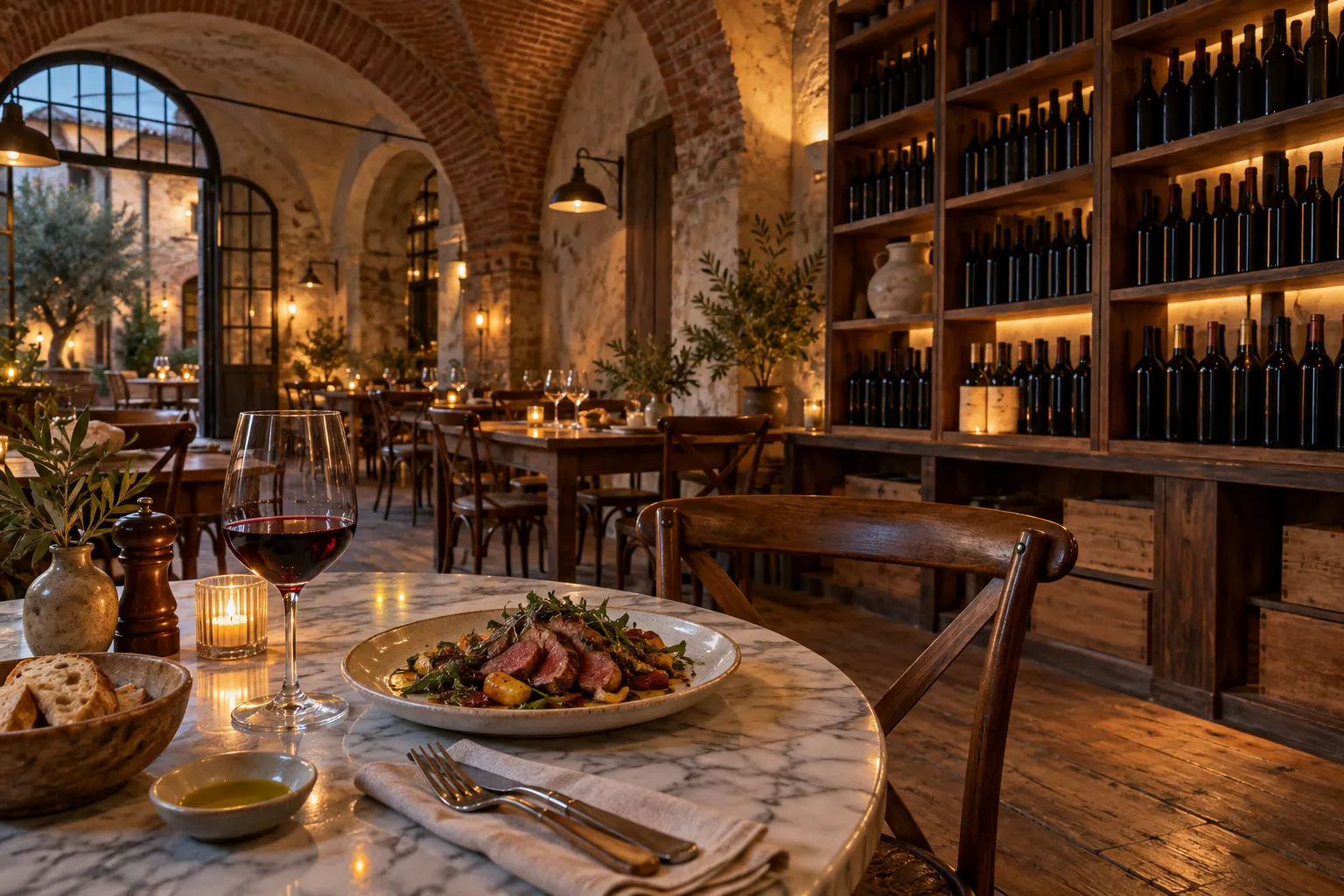
The name means the holy drinker, and the room was a wine warehouse before it was anything else.
It sits on the Oltrarno side, away from the galleries, on a street of furniture restorers and picture framers. Long wooden tables, white walls, shelves of bottles, paper menus printed each day because the menu changes with what arrived that morning.
The cooking is Tuscan but not museum Tuscan — there will be a ribollita and a peposo, and there will also be something with raw fish or a vegetable treatment that would have baffled a cook here fifty years ago. The wine list runs long and deep into small Tuscan producers, and the staff will steer you if you let them.
- Hours: 12:30–23:00 (open daily)
- Address: Via di Santo Spirito 64r, 50125 Florence
- Nearest transport: Santo Spirito · C3 · 5 min walk (C3 · D)
- Printed daily menu that changes with the market. Booking advised in the evening; it fills after eight. Long wine list by the glass as well as the bottle. The back room is quieter than the front.
Local tips
- Book for the evening or come at opening; the front fills first.
- Ask the staff to pick the wine — the list is deeper than it looks and they know it.
- Peposo is the dish to order if it is on; it comes from the kiln workers who built the Duomo.
- The square at Santo Spirito, two minutes away, is worth a drink before or after.
- The street outside is full of restoration workshops; walk it in daylight.
Shops: verified local picks
Scuola del Cuoio

The leather school is inside a monastery, and it was founded to teach a trade to boys orphaned by the war.
In 1950 the Franciscan friars of Santa Croce and two Florentine leather families set it up in the old dormitory behind the basilica. The idea was simple: give the children of the war something they could earn a living with. It has been running ever since and now trains people from all over the world.
You walk in through the church cloister or down a long frescoed corridor from Via San Giuseppe, and the workshop is open — benches, gold-leaf tooling irons heating, someone skiving an edge down to nothing. They do not mind being watched; the watching is part of what the place is.
- Hours: 10:00–18:00 (closed Sunday)
- Address: Via San Giuseppe 5r, 50122 Florence
- Nearest transport: Santa Croce · C2 · 4 min walk (C2 · C3)
- Inside the Santa Croce monastery complex; entrance through the basilica or from Via San Giuseppe. The workshop is open to watch while artisans work. Gold-leaf monogramming is done on site, usually in under an hour. Closed Sunday afternoons in winter.
Local tips
- Enter from Via San Giuseppe if the basilica has a queue — the corridor is the better arrival anyway.
- Watch the benches before you look at the shelves; that is the point of coming.
- Monogramming in gold leaf takes about forty minutes and costs little.
- Smell the leather — vegetable-tanned smells of earth, chrome-tanned smells of chemicals.
- The stalls in the market outside are a different trade entirely.
Officina Profumo-Farmaceutica di Santa Maria Novella
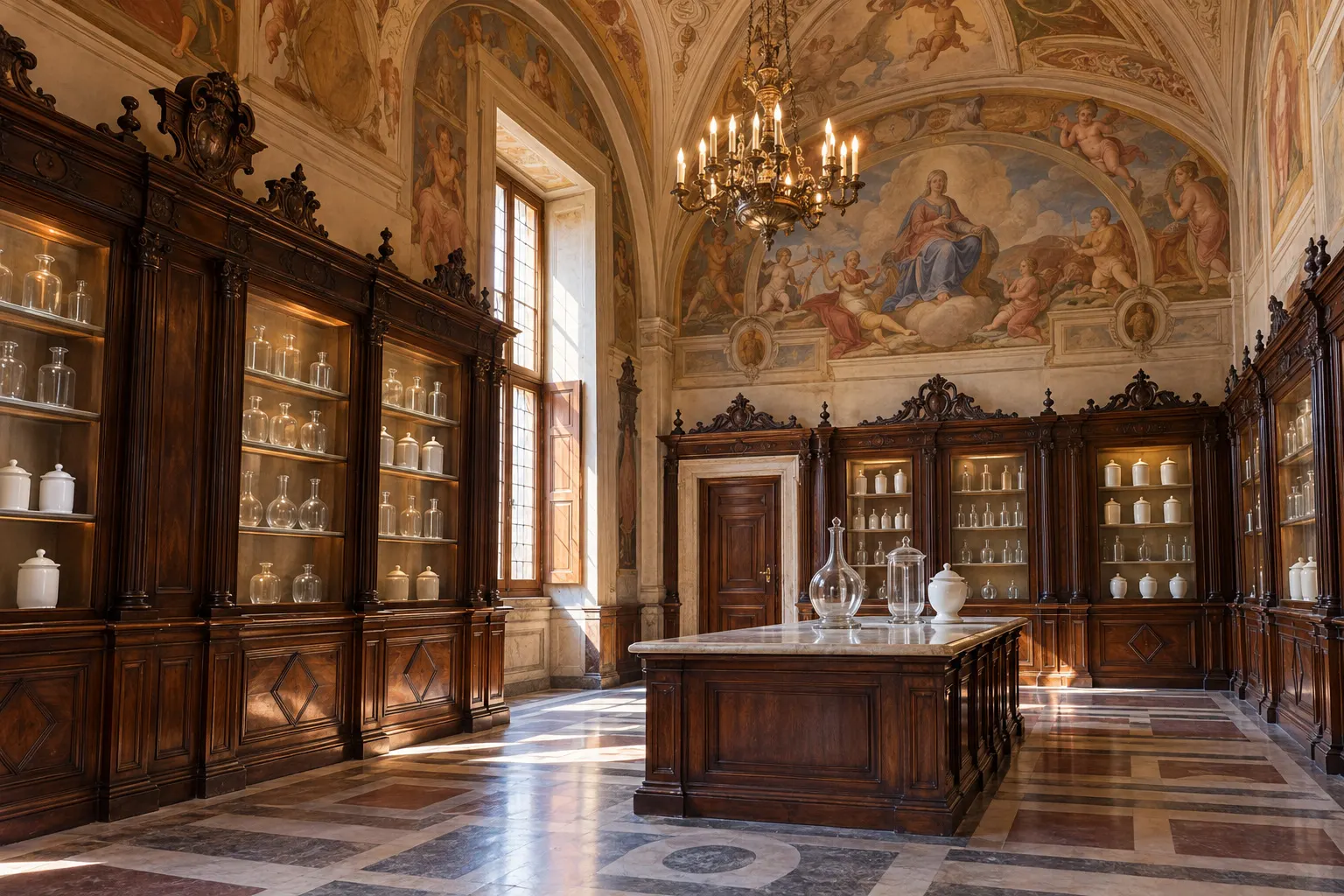
Dominican friars started growing herbs here in 1221 to make remedies for their infirmary. They never stopped.
It opened to the public in 1612 and is one of the oldest pharmacies in the world still trading. You walk in off a plain street into a frescoed hall with vaulted ceilings, glass cabinets and the smell of eight hundred years of distilling.
Acqua di Santa Maria Novella was blended in 1533 for Catherine de' Medici to take to France, where it became known as water of the queen. It is still sold. So is a rose water the friars made for washing floors during the plague, and a pomegranate line, and smelling salts in a glass bottle.
The back rooms are a small museum: old majolica jars, brass stills, the original apothecary furniture.
- Hours: 09:30–20:00 (open daily)
- Address: Via della Scala 16, 50123 Florence
- Nearest transport: Santa Maria Novella · T1 · 5 min walk (T1 · C2)
- A working shop in frescoed former chapel rooms, with a small museum at the back. Staff bring products to you at a counter rather than letting you browse shelves. Liquids need hold luggage. Open seven days but shorter hours on Sundays.
Local tips
- Go through to the back rooms; there is a small museum most shoppers never see.
- Ask for Acqua della Regina — the 1533 formula made for Catherine de' Medici.
- The rose water was a plague-era floor wash and is now the best-selling thing here.
- Staff serve from behind a counter; tell them what you are looking for rather than hunting.
- Everything liquid goes in hold luggage.
Experiences and activities
Fresh Pasta Class with Unlimited Wine

Egg pasta is a northern Italian thing, and Tuscany sits at the edge of where it stops.
South of here the dough is flour and water, shaped by hand, because historically there were no eggs to spare. North of here it is flour and yolk, rolled thin, cut into ribbons. Tuscany does both and argues about it.
You make it by hand: the well of flour, the eggs broken into the middle, the long business of kneading until the dough stops fighting back. Then rolling, which is harder than it looks and is the part people remember. Tagliatelle, ravioli, sometimes pici — the thick hand-rolled Tuscan strand that looks like a worm and is the oldest shape in the region.
- Time to allow: 3 hours
- Hours: 10:00–21:00 (open daily)
- Address: San Lorenzo, 50123 Florence
- Nearest transport: San Lorenzo · C1 · 3 min walk (C1 · C2)
- Localada perk: 5% OFF – Fresh pasta class with unlimited wine — book below
- A hands-on class of about three hours ending with the meal you made. Wine is included and unlimited. Vegetarian adaptation is standard; tell them in advance about gluten or egg. Groups are small and aprons are provided.
Local tips
- Come hungry and do not plan dinner afterwards.
- The rolling is the hard part — ask the chef to show you the hand position twice.
- Ask about pici; it is the Tuscan shape and not every class makes it.
- They will give you the recipes, but the dough ratio is the only thing you need.
- Book ahead; this one fills further out than anything else in the city.
The Perfume Masterclass
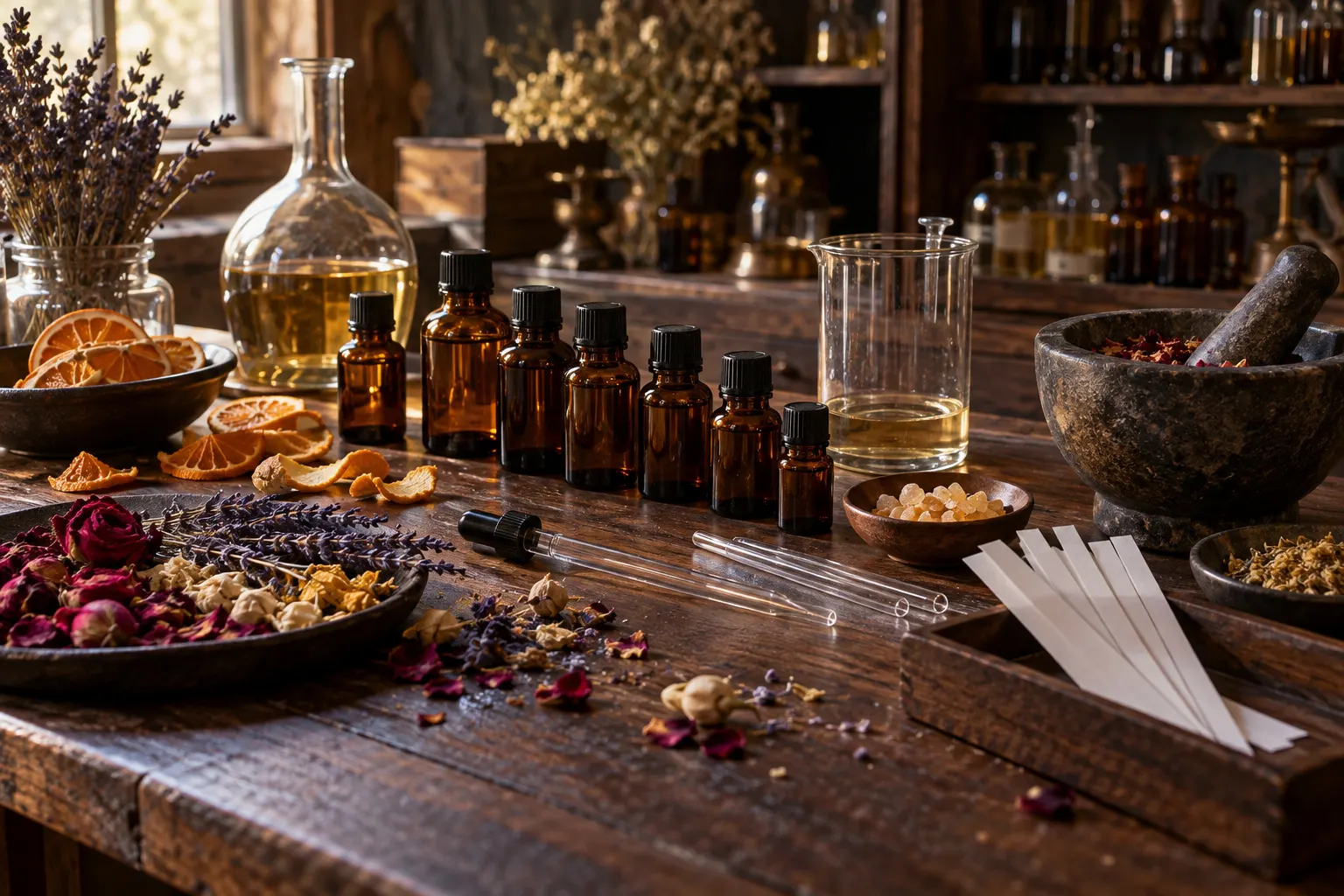
Florence has been making perfume since Dominican friars started distilling in a monastery garden in the thirteenth century.
The trade went to France with Catherine de' Medici, who married into the French court in 1533 and brought her perfumer with her. He is usually credited with starting the whole Grasse industry. The Florentine originals stayed where they were and kept working.
In the class you learn how a perfume is built — base, heart and top notes, and why the thing you smell in the first ten seconds is not what you will be wearing in an hour. Then you work through the organ of raw materials, iris root and bergamot and vetiver and the strange animal ones, and blend your own.
- Time to allow: 2 hours
- Hours: 10:00–19:00 (closed Sunday)
- Address: Santa Maria Novella, 50123 Florence
- Nearest transport: Santa Maria Novella · T1 · 6 min walk (T1 · C2)
- Localada perk: 5% OFF – Perfume masterclass and sensory experience — book below
- A seated workshop of about two hours; you blend and bottle a perfume to take away. Small groups. The room is heavily scented — say in advance if anyone is sensitive. The formula is kept on file so the scent can be reordered later.
Local tips
- Do not wear perfume to the class; it fights with what you are smelling.
- Ask for iris in your blend — it is the Florentine note and the city's symbol.
- Coffee beans are on the table to reset your nose; use them between strips.
- The top note you fall in love with will fade first; build around the base.
- The Officina di Santa Maria Novella nearby sells the thirteenth-century originals.
Pizza & Gelato Making Class
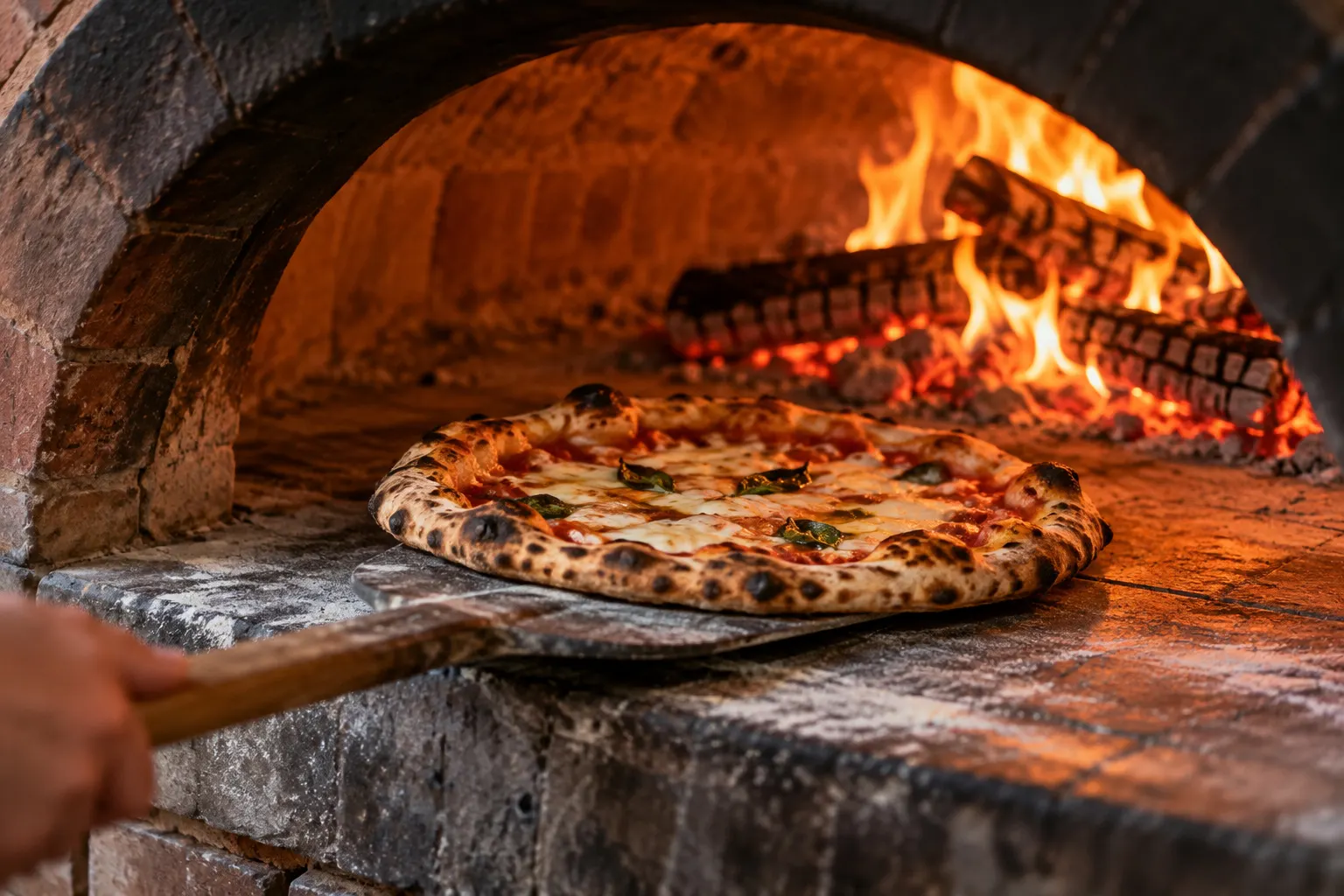
Gelato was probably invented here, and the person usually credited was an architect.
Bernardo Buontalenti designed fortifications for the Medici and also built them an ice house. The story is that in the 1560s he served a frozen cream flavoured with bergamot, lemon and orange at a banquet for visiting Spaniards. The flavour still exists and is still called Buontalenti.
Gelato is not ice cream. Less fat, less air, served warmer — about minus twelve rather than minus eighteen — which is why it tastes stronger and melts faster on the spoon.
In the class you make the base, churn it, and find out why the stuff piled up in mountains behind glass in tourist shops is wrong: real gelato slumps, sits in a covered metal tin, and comes in colours that look duller than you expect.
- Time to allow: 3 hours
- Hours: 10:00–22:00 (open daily)
- Address: Oltrarno, 50125 Florence
- Nearest transport: Pitti · C3 · 6 min walk (C3 · D)
- Localada perk: 5% OFF – Pizza making class with unlimited gelato and wine — book below
- Hands-on class of about three hours covering both pizza and gelato, with wine. Vegetarian is standard; tell them in advance about gluten or dairy. Small groups, aprons provided, you eat what you make.
Local tips
- Ask for the Buontalenti flavour; it is the original and most places no longer make it.
- Do not roll pizza dough with a pin — the class will show you why.
- Bright, piled-high gelato in a shop window is a warning sign; flat and covered is the good stuff.
- Pistachio should be dull green-brown, not bright green.
- The class is in Oltrarno, which is worth an hour on either side.
Florentine Steak & Wine Food Walk
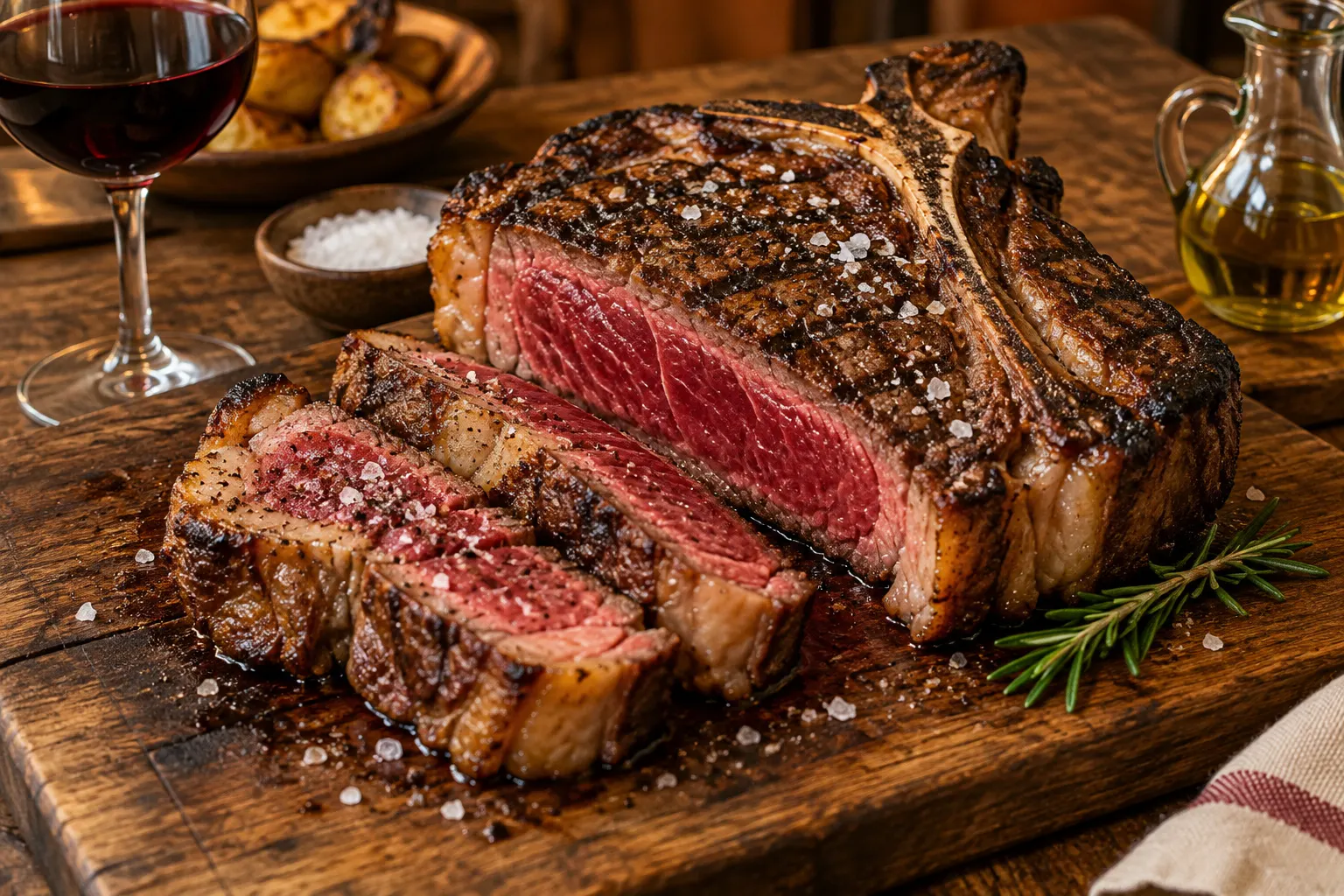
Bistecca alla fiorentina has rules, and they are not negotiable here.
It is a T-bone from a Chianina cow, a white breed raised in the valley south of here since Roman times. It is cut at least three fingers thick. It is grilled over wood or charcoal, five minutes a side, stood on the bone for a few minutes more, and it is served rare. If you ask for it well done you will be told no, politely, and that is not theatre.
The walk goes through the market and the side streets: lampredotto from a cart — the fourth stomach of a cow, simmered, in a bread roll, which is the Florentine street food and much better than it sounds — then pecorino, finocchiona salami with fennel, schiacciata bread, and Chianti alongside.
- Time to allow: 3–4 hours
- Hours: 10:00–21:00 (closed Sunday)
- Address: Mercato Centrale, San Lorenzo, 50123 Florence
- Nearest transport: San Lorenzo · C1 · 2 min walk (C1 · C2)
- Localada perk: 5% OFF – Food walking tour with Florentine steak and Tuscan wine — book below
- Walking tasting of three to four hours with several stops, ending with the steak. Plenty of food included. Tell the operator in advance about beef, pork or gluten — much of the route is built around them. Comfortable shoes.
Local tips
- Try the lampredotto even if the description puts you off; it is the local test.
- The steak is served rare by rule — if that does not work for you, say so when booking.
- Finocchiona exists because fennel seed was cheaper than pepper; ask the stallholder.
- Morning walks catch the market working rather than performing.
- Skip lunch. Genuinely.
Paint & Wine over the Ponte Vecchio
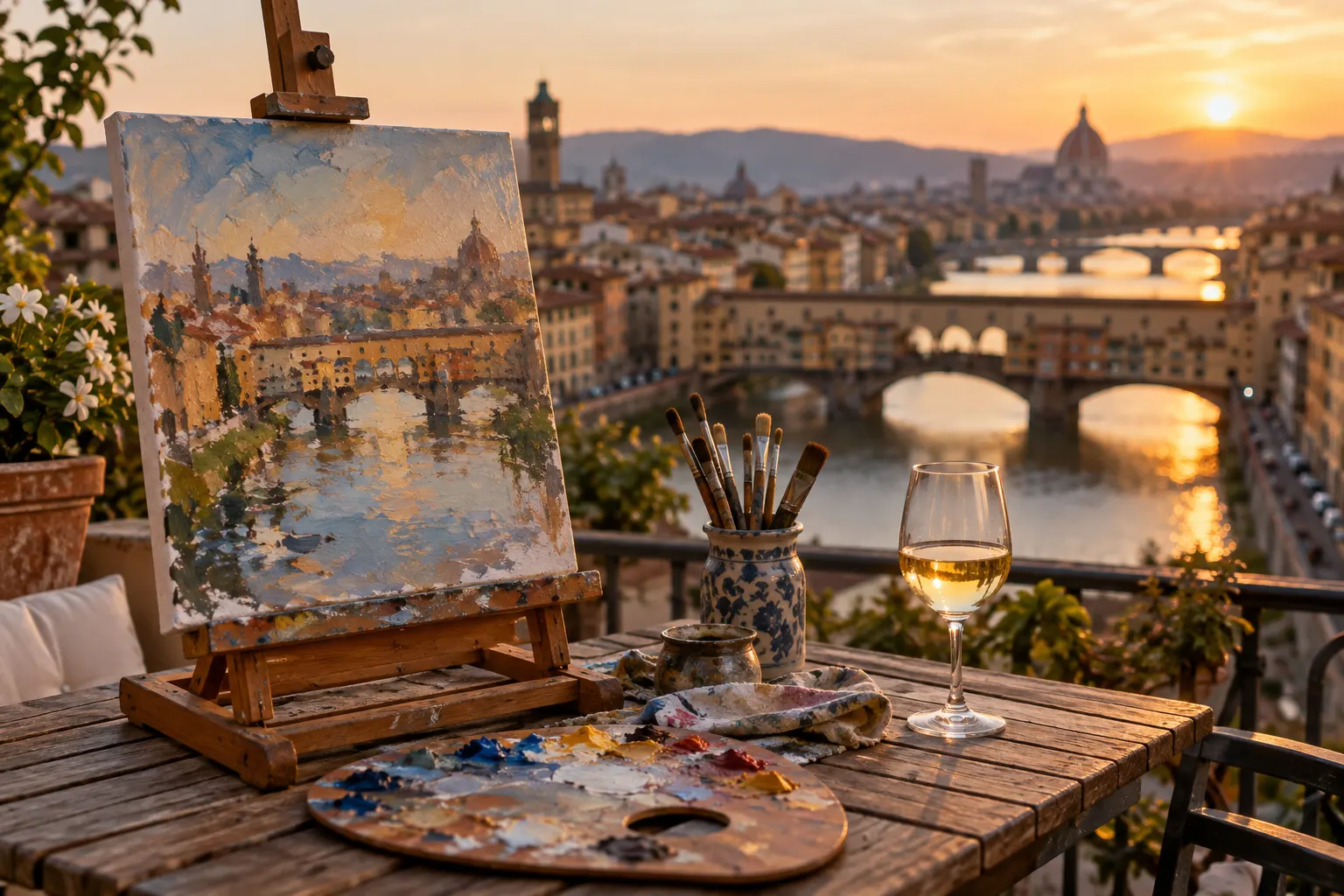
Everyone photographs the Ponte Vecchio. Almost nobody sits down and looks at it for two hours.
That is the whole idea. A terrace above the river, an easel, paints, a glass of something, and a bridge that has been standing since 1345 in front of you. No experience needed and the point is not the painting.
What you notice when you are forced to look is how little of it is a bridge. Shops were built onto it in the fourteenth century and then extended outwards on timber brackets hanging over the water, which is why the back of it looks like a row of houses falling into the Arno. The windows are all different because each shopkeeper built their own.
Above the shops runs the Vasari Corridor, a kilometre-long private passage the Medici used to walk from the Palazzo Vecchio to the Pitti without touching the street.
- Time to allow: 2 hours
- Hours: 10:00–20:00 (open daily)
- Address: Oltrarno, 50125 Florence
- Nearest transport: Ponte Vecchio · C3 · 4 min walk (C3 · D)
- Localada perk: 5% OFF – Paint and wine with a view of the Ponte Vecchio — book below
- A relaxed two-hour session on a terrace with materials and a drink included. No painting experience needed. Weather-dependent — wet days move indoors and lose the view. Small groups, canvases are yours to take.
Local tips
- Late afternoon light on the bridge is the reason to take the later slot.
- Count the window shapes on the overhanging shops; no two builders agreed.
- The Vasari Corridor is the row of small square windows above the shops.
- The canvas comes with you — it will not fit in hand luggage flat, so plan for that.
- If the forecast is wet, check whether they are moving indoors before booking.
Florence audio guide: frequently asked questions
Is the Florence audio guide free?
Yes. Localada’s Florence guide is free: create a free account and open it in your browser, no app download needed. It includes 16 stops, audio and written stories, a route map and scam-awareness tips. Tickets for paid sights are bought separately; booking through Localada’s GetYourGuide links gives 5% off.
How many stops are in the Florence audio guide?
There are 16 stops: 7 sights, 2 places to eat, 2 shops and 5 experiences.
How long does it take to see the main sights in Florence?
Visiting all 7 sights in the guide takes about 10.5–13.5 hours, not counting travel between them. The Uffizi Gallery needs the most time (allow 2–3 hours).
Which Florence sights are closed on certain days?
6 of the 7 sights have a weekly closing day: The Duomo & Brunelleschi's Dome (closed Sunday), The Uffizi Gallery (closed Monday), The Accademia & Michelangelo's David (closed Monday), The Pitti Palace & the Boboli Gardens (closed Monday), The Medici Chapels & San Lorenzo (closed Sunday) and The Bargello (closed Sunday). Plan these for another day of the week.
What time do Florence sights open and close?
The earliest opening in the guide is 08:15 (The Uffizi Gallery) and the latest closing is 19:00 (Palazzo Vecchio & the Secret Passages). Each stop’s hours are in the table above.
Are there discounts with the Florence guide?
12 stops include a Localada perk, for example The Duomo & Brunelleschi's Dome (5% OFF), The Uffizi Gallery (5% OFF), The Accademia & Michelangelo's David (5% OFF), Palazzo Vecchio & the Secret Passages (5% OFF), The Pitti Palace & the Boboli Gardens (5% OFF) and The Medici Chapels & San Lorenzo (5% OFF). Show the code in the guide at verified restaurants and shops; ticket discounts are applied at GetYourGuide checkout.
What can I do in Florence on a rainy day?
11 stops in the guide are indoors, including The Duomo & Brunelleschi's Dome, The Uffizi Gallery, The Accademia & Michelangelo's David, Palazzo Vecchio & the Secret Passages, The Pitti Palace & the Boboli Gardens and The Medici Chapels & San Lorenzo.
What is open in the evening in Florence?
These stops in the guide stay open late: Fresh Pasta Class with Unlimited Wine (until 21:00), Pizza & Gelato Making Class (until 22:00), Florentine Steak & Wine Food Walk (until 21:00), Trattoria Sostanza (until 22:00) and Il Santo Bevitore (until 23:00).
How do I get between the stops in Florence?
The Florence route is designed to be walked: the stops sit close together and the map shows the walking order.
Which languages is the Florence audio guide available in?
Narration and text are available in 15 languages: English, Turkish, German, French, Spanish, Italian, Portuguese, Dutch, Polish, Russian, Arabic, Persian, Chinese, Japanese and Korean.