
















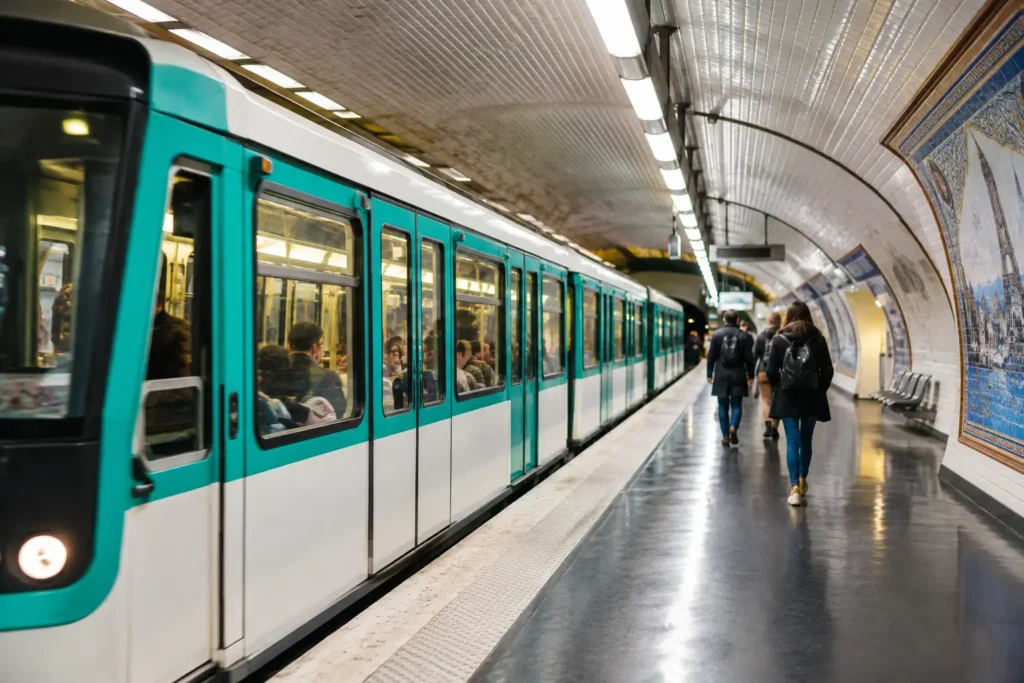
Paris Metro versus RER comes down to distance: take the Metro for frequent stops within Paris, and the RER for faster trips across the city or out to airports, Versailles, and Disneyland Paris. They connect well, but they are not interchangeable, and choosing the wrong one can add unnecessary walking, transfers, or confusion.
Transit Essentials 2026
Time needed: Allow 10 to 20 minutes for a typical Metro journey within central Paris, plus time to find the correct platform and exit. Allow extra time for RER airport trips, especially with luggage.
Operating hours: Most Metro lines begin around 5:30 a.m. and finish shortly after 1:00 a.m. On Friday and Saturday nights, final trains generally run later. RER hours vary by line, branch, and destination, so use the official RATP journey planner for the exact last train.
Closed days: Neither system has regular weekly closure days. Engineering work can affect specific lines, stations, and RER branches, particularly late evenings and weekends.
Dress code: There is no dress code. Wear shoes you can manage on stairs, and keep bags close in crowded carriages and passageways.
Booking ahead: No reservation is needed for ordinary Metro or RER travel. Buy the appropriate ticket or travel pass before reaching the gates, and keep it until you have left the station.
Nearest station: There is no single nearest stop for Paris. For central landmarks, Metro stations are usually closer than RER stations. For Charles de Gaulle Airport, RER B serves the airport terminals; for Versailles Château Rive Gauche, RER C is the usual rail connection.
Paris Metro versus RER Network Differences
The Paris Metro is the dense city network. Its lines serve central neighborhoods closely, with stations often only a few blocks apart. If you are traveling from the Louvre area to Saint-Germain-des-Prés, from Montmartre to the Marais, or between most museums in the central arrondissements, the Metro is usually the practical choice.
The RER is a regional express rail network that passes through central Paris before branching into the suburbs. Its trains stop less often than the Metro and cover longer distances more quickly. That makes it useful when your destination is farther away, but less useful for a short hop between nearby sights.
Think of the systems this way: the Metro gets you to a neighborhood; the RER gets you across Paris or beyond it. A RER train may pass through central stations such as Châtelet-Les Halles, Saint-Michel Notre-Dame, Invalides, or Gare du Nord, but it will not necessarily stop near the exact street you need.
The distinction matters because Paris stations can be large. A transfer at Châtelet-Les Halles, for example, can involve long corridors, multiple levels, crowds, and several exits. It is efficient when you need it, but it is not a shortcut for every journey.
Best Uses for the Metro
Use the Metro when you are sightseeing within the main city area and want the closest stop to your destination. It is especially useful for the Louvre, the Eiffel Tower area, the Latin Quarter, the Marais, Montmartre, Canal Saint-Martin, and most central shopping streets.
Metro maps can look intimidating, but the key is the line number and final destination shown on the platform signs. Before boarding, check the direction by looking for the train’s terminus, not only its line number. On Line 1, for example, a train heading toward La Défense travels west; one heading toward Château de Vincennes travels east.
Many Metro stations have several exits. Use the exit signs marked with nearby streets, landmarks, or neighborhood names rather than taking the first staircase you see. This small habit saves time and reduces the chance of emerging on the wrong side of a major road or square.
The Metro can feel cramped at rush hour, roughly 8:00 to 10:00 a.m. and 5:00 to 7:30 p.m. If you have a large suitcase, avoid those periods where possible. Not every station has an elevator, and some transfers involve several flights of stairs.
Best Uses for the RER
Choose the RER when distance matters. RER B is the main rail link between Charles de Gaulle Airport and central Paris. RER C is commonly used for Versailles Château Rive Gauche, although service patterns and works can affect the best route. RER A is a common option for Disneyland Paris, using the Marne-la-Vallée-Chessy branch.
Within central Paris, the RER can also save time on longer north-south or east-west journeys. For example, RER B connects Gare du Nord, Châtelet-Les Halles, Saint-Michel Notre-Dame, and Denfert-Rochereau. If those stations fit your route, it can be faster than a series of Metro stops.
The trade-off is that RER branches matter. A line letter alone is not enough. On RER A, B, C, D, and E, trains may continue to different suburbs. Check both the line and the final destination displayed on the platform board. If you are heading to an airport, Versailles, or Disneyland Paris, confirm the destination before boarding rather than assuming every train on that line goes there.
RER platforms can also be shared by trains with different stopping patterns. Screens normally show the next train, its destination, and major stops. Take a moment to read them. Two minutes spent checking is better than a long ride in the wrong direction.
Transfers, Tickets, and Station Navigation
A Metro-to-Metro transfer is usually straightforward, though some stations are much larger than they appear on a map. A Metro-to-RER transfer may require following signs through long tunnels. If you are traveling with children, a stroller, or luggage, build in extra time and do not attempt a tight airport connection.
The ticket rules depend on your route, not simply whether you see an M or an RER sign. A trip entirely within central Paris may use a different ticket arrangement from an airport or suburban RER journey. Buy the correct option before entering and keep your ticket, card, or phone ready until the journey is complete. Ticket inspections do happen, including on platforms and near exits.
Do not rely on a paper map alone for disruption information. Use the official RATP app or website on the day you travel for live service notices, planned closures, elevator status, and alternate routes. At stations, follow the electronic boards rather than old posters or unofficial advice from strangers.
If a gate does not open, use the staffed information point or official help button where available. Do not follow someone through an accessible gate and do not accept a stranger’s offer to “help” you buy a ticket in exchange for cash.
Safety and Luggage Awareness
Paris public transport is widely used by residents and visitors, and most journeys are uneventful. The main issue for travelers is opportunistic theft in crowded spaces, particularly at station entrances, on escalators, near doors, and when people are distracted by maps or luggage.
Keep your phone, passport, and payment cards in a zipped inside pocket or a bag worn in front of you. Do not place a phone in an open coat pocket or on a café table while waiting near a station. On a crowded train, hold your bag rather than leaving it on the floor or luggage rack.
Be cautious if someone creates a distraction, such as dropping something, pressing close to you at a door, or insisting your ticket is invalid. Official staff can identify themselves and work through official channels. If you need urgent help, call 112. For police in France, call 17; for fire and rescue, call 18.
Frequent Mistakes for First-Time Visitors
The most common mistake is treating all RER trains as airport or tourist trains. Always check the final destination and intermediate stops. The second is using the Metro for an airport journey simply because it looks familiar. A direct RER route may be easier, even if it has fewer stops near your hotel.
Another mistake is underestimating walking inside major interchange stations. Châtelet-Les Halles, Gare du Nord, and Saint-Lazare are not quick platform changes for every traveler. If a route offers a slightly longer ride with fewer transfers, it can be the calmer choice.
Finally, do not confuse a station’s name with a guaranteed landmark entrance. A Metro stop may be near a large site but still leave you with a 10-minute walk to the correct gate. Check the exit name and your destination address before you leave the platform.
Frequently Asked Questions
Is the RER faster than the Metro?
Yes, but mainly for longer cross-city trips and destinations outside central Paris. For nearby sights, the Metro is often quicker because its stops are closer together.
Can I take the RER from Charles de Gaulle Airport?
Yes. RER B connects Charles de Gaulle Airport with central Paris stations including Gare du Nord, Châtelet-Les Halles, and Saint-Michel Notre-Dame.
Does every RER train go to the same destination?
No. RER lines split into branches, so check the platform screen and the train’s final destination before boarding.
Is the Metro easy to use with a suitcase?
Usually, but stairs, narrow gates, and crowded transfer tunnels can make it tiring. Leave extra time and avoid peak commuting periods when possible.
How long should I allow for a transfer at Châtelet-Les Halles?
About 10 to 15 minutes. It can be faster when you know the station, but first-time visitors should not plan a tight connection there.
Should I keep my ticket after entering the station?
Yes. Keep it until you have fully completed your journey, as you may need it for exit gates or a ticket inspection.
For on-the-ground help, the free Localada Paris guide lists each stop’s hours, closing days and how long to allow, with narrated stories in 15 languages, scam warnings and verified local restaurants and shops. Booking tickets through its GetYourGuide links saves 5%.
Sources and official information
Opening hours, prices and rules change. These are the primary sources behind this guide; check them before you go.
- RATP: tickets and fares: The Paris transport operator’s official ticket and fare information.
- UNESCO World Heritage Centre: Paris, Banks of the Seine: World Heritage listing for central Paris along the Seine.
- Paris Police Prefecture: Staying safe in Paris (PDF): Police guidance for visitors on theft, scams and how to report them.
- Musée du Louvre: hours and admission: Official opening hours, closing day and ticket rules.
- UK Foreign Office travel advice: France safety and security: Government guidance on theft on the Paris Metro, RER and at major stations.
Questions answered in this article
Summarise this guide with AI: ChatGPT · Claude · Perplexity