
















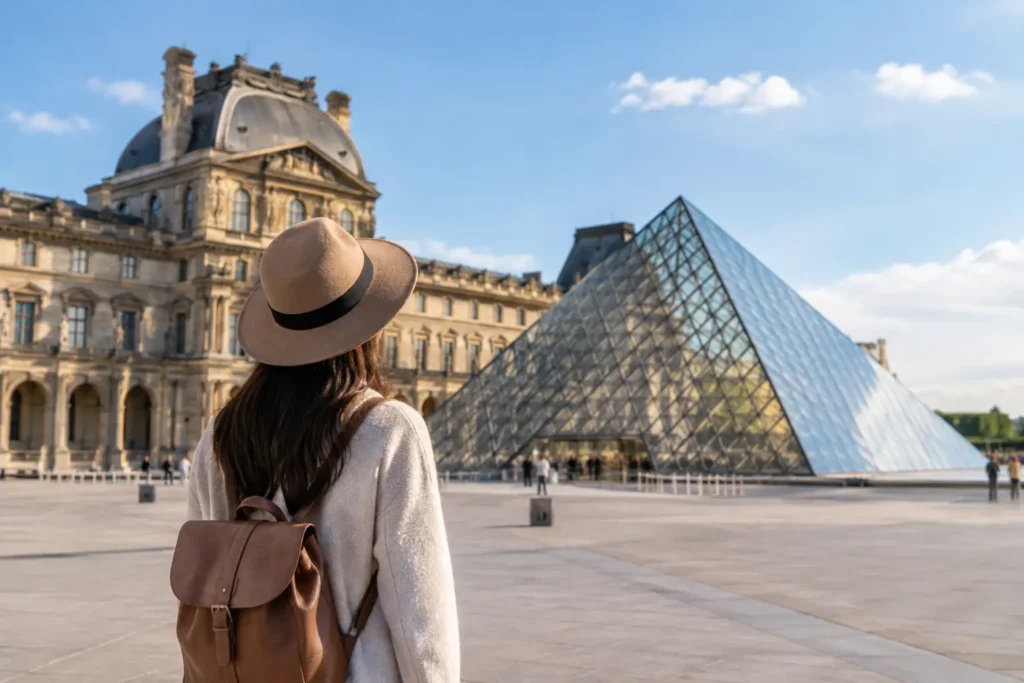
You can enjoy a Louvre visit without a guided tour, but only if you treat it as a focused museum visit rather than an attempt to see everything. Reserve a timed entry, choose two or three collections before you arrive, and give yourself permission to walk past rooms that do not interest you.
Louvre Essentials 2026
- Realistic visit time: Allow 2.5 to 3 hours for a first independent visit. Four hours works well if you want paintings, sculpture, and one decorative-arts section.
- Opening hours: The Louvre is generally open from 9:00 a.m. to 6:00 p.m. on Monday, Thursday, Saturday, and Sunday, and until 9:00 p.m. on Wednesday and Friday. It is closed on Tuesday. Last entry is one hour before closing, and galleries begin clearing 30 minutes before closing.
- Nearest Metro: Palais Royal-Musée du Louvre on Metro Lines 1 and 7 is about a 3 to 5 minute walk from the Pyramid entrance. Pyramides on Lines 7 and 14 is about an 8 minute walk.
- Dress code: There is no formal dress code. Wear closed, comfortable walking shoes, bring a light layer for air-conditioned galleries, and avoid bulky bags.
- Book ahead: Reserve an official timed-entry ticket before traveling to the museum. A timed ticket controls your entrance time, not the time you may remain inside.
The museum’s published hours and gallery access can change for special events, strikes, or maintenance. Confirm your date on the Louvre’s official visitor information before leaving your hotel, particularly if you are planning a Wednesday or Friday evening visit.
Timed Entry and the Right Entrance
For most independent travelers, the Pyramid is the simplest entrance. Arrive about 20 to 30 minutes before your timed slot for security and ticket checks. Do not arrive an hour early expecting to be admitted immediately. Staff may ask visitors to wait until closer to their reserved time.
Use the official Louvre ticket channel. Around the museum and nearby Metro exits, ignore anyone claiming that tickets are sold out, that the museum is unexpectedly closed, or that they can take you through a faster private entrance. The Louvre is a major attraction and entry procedures can feel busy, but you do not need a stranger’s help to enter.
Large luggage is not permitted. The museum’s bag limit is 55 x 35 x 20 cm, and all bags are screened. Lockers may be available for permitted items, but do not plan your day around storing suitcases. Visit after checking into your accommodation or leave luggage at your hotel.
Louvre Visit Without a Guided Tour: A Better Route
The Louvre has three main wings: Denon, Sully, and Richelieu. They are connected, but they are not a simple loop. Start with the works you care about most, because backtracking through the building costs more time than most first-time visitors expect.
A practical 3-hour route begins in the Denon Wing. Go first to the Winged Victory of Samothrace at the top of the Daru staircase, then continue toward the Mona Lisa. The staircase itself is worth a pause, and it is often easier to appreciate before the crowd thickens.
For the Mona Lisa, expect a controlled viewing area and a crowd. You may not get a long, quiet moment in front of the painting. That is normal. Take your look, step aside, and continue through the Grande Galerie, where the surrounding Italian paintings reward far more time than the single famous portrait.
Next, move toward the Sully Wing for the Venus de Milo and the Egyptian antiquities galleries. If ancient history is a priority, you could spend the rest of your visit here. If it is not, see the Venus de Milo, choose one Egyptian section, and move on without guilt.
Finish in the Richelieu Wing if you still have energy. The Napoleon III Apartments are a strong choice for visitors who want to see how the former palace functioned as a setting for power and display. The rooms are richly furnished and visually different from the painting galleries, which makes them a good final stop.
This route is not a rule. Travelers interested in Islamic art, Mesopotamia, medieval sculpture, or French decorative arts should build around those departments instead. The best self-guided visit is selective, not comprehensive.
Gallery Priorities and Realistic Expectations
Trying to see the entire Louvre in one day is exhausting and rarely satisfying. Before entering, choose one anchor from each of these categories: a major painting, a major sculpture, and one collection that genuinely interests you. That gives your visit shape without turning it into a checklist.
The museum’s room numbers and gallery closures can change. Pick up a free paper map if available, or use the Louvre’s official map on your phone. Save your chosen rooms before going underground, where mobile signal can be weaker in some areas.
If you are visiting with children, keep the plan shorter. A 90-minute route centered on the Winged Victory, Mona Lisa, Venus de Milo, and one room of Egyptian objects is often more successful than a four-hour march. Add a snack and bathroom break before the final gallery rather than waiting until everyone is tired.
Evening Visits and Quiet Corners
Wednesday and Friday evenings are often the best choice for travelers who dislike the pressure of a full daytime visit. The later closing time creates more room for a slower route, though popular works can still be crowded. Begin with the Mona Lisa or another headline work, then use the later hours for galleries that are less crowded.
Quieter does not mean empty. School groups, tour groups, and independent visitors all use late openings. The advantage is not guaranteed solitude. It is having more time to recover if security, navigation, or the Mona Lisa crowd slows you down.
Avoid building a Louvre visit around the first Friday evening of the month, when admission is generally free after 6:00 p.m., except in July and August. Free-entry periods can be especially busy, and reservation rules may apply. Visitors under 18 and some younger European residents may qualify for free admission, but they should still review the Louvre’s current reservation instructions before arriving.
Museum Navigation and Personal Safety
The Louvre is safe to visit independently. The practical risks are ordinary city-travel problems: losing time in crowds, misplacing belongings, or being approached by unofficial sellers outside the museum. Keep your phone and wallet in a zipped pocket or closed bag while using the Metro and around the Pyramid.
Inside, take a photo of the nearest room number if your group separates. Choose one meeting point before you start, such as beneath the Pyramid after exiting security. The museum is large enough that “meet by the stairs” is not a useful plan.
For emergencies in France, call 112 for the European emergency number, 17 for police, 18 for fire and rescue, and 196 for emergencies at sea. For a lost item inside the museum, ask uniformed Louvre staff rather than relying on a person who approaches you first.
Frequently asked questions
Can I see the Mona Lisa without a guided tour?
Yes, but you still need a valid museum entry reservation or ticket. Follow signs for the Denon Wing and expect a managed viewing area around the painting.
Is three hours enough for the Louvre?
Yes. Three hours is enough for a strong first visit if you choose a route and limit yourself to a few priority collections.
Is the Louvre closed on Tuesdays?
Yes. The museum is generally closed every Tuesday, including Tuesday daytime hours when nearby Paris attractions may remain open.
Can I bring a backpack into the Louvre?
Only if it is within the museum’s 55 x 35 x 20 cm bag limit and passes security screening. Large luggage is not allowed.
Which Metro stop is closest to the Louvre?
Palais Royal-Musée du Louvre. It is served by Metro Lines 1 and 7 and is around a 3 to 5 minute walk from the Pyramid entrance.
Are Louvre evening openings worth it?
Yes, especially if you prefer a less rushed visit. Wednesday and Friday late openings give you more time, although famous galleries can still be crowded.
If you want this guidance while you walk, open the free Paris audio guide on Localada: opening hours, time to allow and local tips for every stop, in 15 languages, with 5% off tickets booked through its GetYourGuide links.
Sources and official information
Opening hours, prices and rules change. These are the primary sources behind this guide; check them before you go.
- Musée du Louvre: hours and admission: Official opening hours, closing day and ticket rules.
- Paris Police Prefecture: Staying safe in Paris (PDF): Police guidance for visitors on theft, scams and how to report them.
- UK Foreign Office travel advice: France safety and security: Government guidance on theft on the Paris Metro, RER and at major stations.
- UNESCO World Heritage Centre: Paris, Banks of the Seine: World Heritage listing for central Paris along the Seine.
Questions answered in this article
Summarise this guide with AI: ChatGPT · Claude · Perplexity