
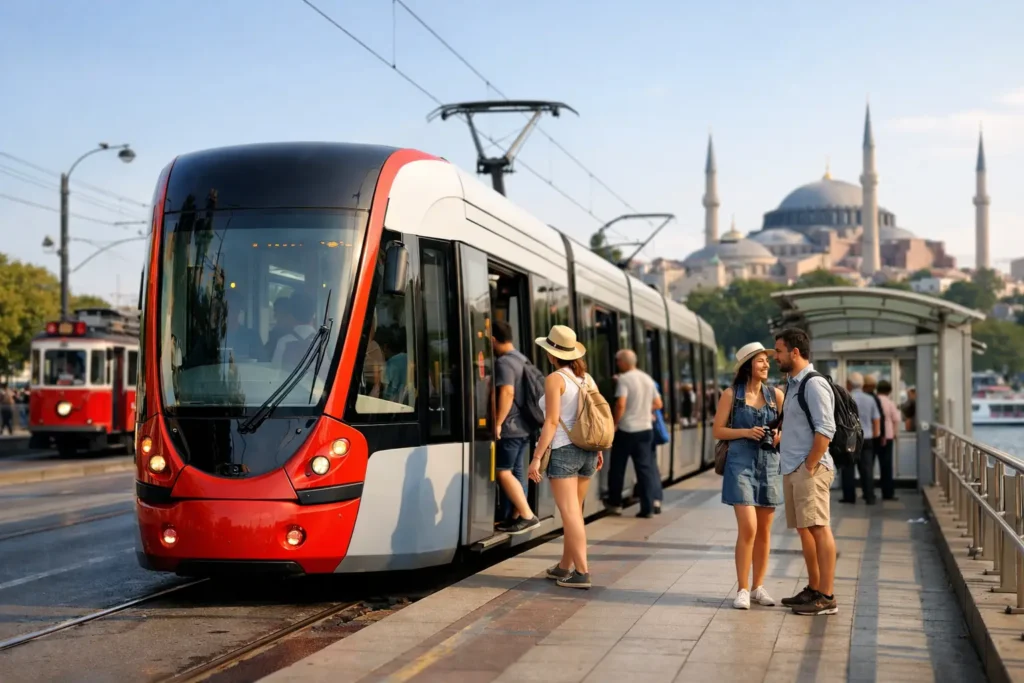
Yes. Istanbul trams are tourist friendly, especially the T1 line linking Sultanahmet with major historic sights, Eminönü, Karaköy, and Kabataş. They are not always relaxed – rush-hour cars can be very full – but they are usually easier, cheaper, and more predictable than negotiating traffic in a taxi.
Tram Essentials 2026
Time needed: Allow 10 to 35 minutes for most central journeys, plus a few minutes to find the platform and tap in. Operating days: T1 and T5 run daily, including weekends. T1 generally operates from early morning until around midnight. Dress code: None for trams or stations. Keep shoulders and knees covered only when entering active mosques near tram stops. Best Old City stop: Sultanahmet on T1. Hagia Sophia, the Blue Mosque, Basilica Cistern, and the Hippodrome are a 2 to 8-minute walk away. What to book ahead: Nothing. Trams do not require reservations. Buy and load an Istanbulkart before boarding.
Istanbul Trams Tourist-Friendly Basics 2026
For an independent visitor, the tram network works well because the central routes are visible, stations are signed in Latin letters as well as Turkish, and the stops you need are close to the places you came to see. You do not need to understand Turkish to use it successfully.
The most useful route is T1, Kabataş-Bağcılar. Think of it as the practical line for the historic peninsula and the waterfront. From Sultanahmet, it reaches Gülhane for the park and Istanbul Archaeological Museums, Sirkeci for the railway station area, Eminönü for the Spice Bazaar and ferries, Karaköy for Galata-side connections, and Kabataş for the funicular toward Taksim.
The key limitation is crowding. Between roughly 8:00 and 10:00 a.m., and again from 5:00 to 7:30 p.m. on weekdays, T1 can be packed with commuters, students, and visitors. If you have large suitcases, a double stroller, or mobility needs, avoid those periods where possible. A short taxi ride may be more comfortable after a long flight, but for sightseeing trips with a day bag, the tram is often the sensible choice.
T1 Stops for Sultanahmet Sightseeing
Sultanahmet is the stop most visitors use first. Exit toward the historic square for Hagia Sophia, the Blue Mosque, the Basilica Cistern, and the Hippodrome. The Grand Bazaar is about 1 km uphill from here, or around a 15-minute walk. You can also use Beyazıt-Kapalıçarşı on T1, which leaves you about 5 minutes from one of the Grand Bazaar entrances.
Gülhane is useful for Gülhane Park and the Istanbul Archaeological Museums. From the platform, the museum entrance is around a 10-minute uphill walk. Topkapi Palace is also reachable from here, but allow 15 minutes on foot and remember that the palace is closed on Tuesdays.
Eminönü is the best stop for the Spice Bazaar, Galata Bridge, ferry piers, and the waterfront. The Spice Bazaar is about 300 meters away, usually a 4-minute walk. This area is busy throughout the day, so keep your phone and wallet in a zipped bag rather than an open coat pocket.
Karaköy and Tophane are practical for crossing into the Galata and Beyoğlu areas. At Kabataş, transfer to the F1 funicular for Taksim. That connection is clearly signposted, though it can be busy in the evening.
Istanbulkart and Station Entry
You need an Istanbulkart or another accepted local transit payment method to pass through the gates. For most visitors, an Istanbulkart is the simplest option. Buy it from official transit machines or authorized sales points, then tap the card on the reader at the station gate.
Do not assume a foreign bank card will work at every gate. Keep an Istanbulkart loaded before you enter a crowded station, particularly before a ferry connection or an airport transfer. Machines can have English-language options, but the process is faster when you know your destination and do not wait until the tram is arriving.
If your group shares one card, each traveler must tap separately. Leave a moment between taps if the gate does not open immediately. For a busy family, separate cards can be less stressful because everyone can move through the gate without holding up the line.
People offering unsolicited help at ticket machines are not automatically trying to mislead you, but you do not need to hand over your card, cash, or phone. If the machine is not working, use another official machine or ask uniformed transit staff. A calm refusal is enough.
Platforms, Transfers, and Direction Signs
Before you tap in, check two things: the line number and the final destination shown on the platform display. On T1, direction matters more than the name of the neighborhood you are standing in. For example, from Sultanahmet toward Eminönü, Karaköy, and Kabataş, use the Kabataş direction. For Beyazıt and the Grand Bazaar, use the Bağcılar direction.
Trams have digital route maps and stop announcements. Stand near a door if you are getting off within one or two stops, but do not block the doorway. Local passengers board quickly, and a little awareness makes the trip easier for everyone.
Transfers can be straightforward, but do not plan them too tightly. The T1, ferries, metro lines, funiculars, and buses meet in busy places such as Eminönü, Karaköy, and Kabataş. Give yourself 10 to 15 minutes for a connection if you are unfamiliar with the station layout or traveling with children.
The newer T5 line is useful for parts of the Golden Horn, running between Cibali and Alibeyköy. It is less central to a first Old City itinerary than T1, but it can be useful if you are staying near the Golden Horn waterfront. Do not confuse it with T1: they are separate lines and do not share a platform.
Luggage, Strollers, and Accessibility
A small suitcase or backpack is manageable outside rush hour. Large luggage is not ideal on T1 because aisle space is limited and you may need to step aside quickly at crowded stops. Keep bags close to your legs, not on a seat or in the doorway.
Many central stops have elevators or step-free elements, but accessibility can vary by entrance, and elevators may occasionally be out of service. If step-free access is essential, allow extra time and identify the elevator entrance before you descend. For a stroller, travel outside peak times and use the wider gate where available.
Trams are generally well lit and used by a broad mix of residents and visitors. The practical safety rule is the same as in any busy transit system: keep valuables closed and in front of you, especially when boarding and exiting. If you need urgent help, call 112. Turkey’s police number is 155, fire is 110, and the coast guard is 158.
When a Tram Is Not the Best Choice
The tram is not the answer to every journey. It does not reach every hotel street in Sultanahmet, and the historic peninsula has hills, cobblestones, and narrow lanes. A map may show a stop nearby while the final 400 meters involve a steep walk with luggage.
Use the tram for sight-to-sight travel, then walk the compact Old City. For example, take T1 to Sultanahmet, visit the major landmarks on foot, and use Beyazıt-Kapalıçarşı or Gülhane when you are ready to move on. Trying to board for one stop in the busiest part of the day is sometimes more effort than simply walking 700 meters.
Frequently asked questions
Is the T1 tram safe for tourists?
Yes, but treat it like any crowded city transit line: keep your phone and wallet secure, and do not let anyone rush you at a ticket machine.
Can I reach Hagia Sophia by tram?
Yes. Take T1 to Sultanahmet, then walk about 5 minutes to Hagia Sophia.
Can I pay for Istanbul trams with a credit card?
No. Do not rely on a foreign bank card at the gate; use an Istanbulkart or an accepted local transit payment method.
Are Istanbul trams running on Sundays?
Yes. T1 and T5 run daily, though wait times and crowd levels can differ from weekday patterns.
How long is the tram ride from Sultanahmet to Eminönü?
About 10 minutes. Add time for waiting, boarding, and walking from the Eminönü stop to your destination.
Is the tram good for airport transfers?
Only partly. The T1 is useful after you reach central Istanbul, but it does not run directly to either airport.
If you want tram directions, Old City walking routes, scam-awareness guidance, and vetted local recommendations in one place, the Localada Istanbul Pack keeps the practical details close at hand for your whole group.