















Pickpocketing is avoidable for most visitors when you protect your phone and payment cards before entering busy spaces, rather than reacting after a distraction begins. This Paris pickpocket prevention guide focuses on calm, practical habits that let you use the Metro, visit landmarks, and enjoy central neighborhoods with more confidence.
Essentials for Paris Safety Planning
Time to read: about 7 minutes. Closed days: none – these habits apply every day, including Sundays and public holidays. Dress code: no special clothing is needed, but avoid open back pockets, loose exterior jacket pockets, and bags that cannot be fully closed. Transport: pickpocketing is most likely where people bunch together: Metro gates, escalators, platforms, train doors, and major interchange stations such as Châtelet-Les Halles, Gare du Nord, République, and Montparnasse-Bienvenüe. Book ahead: reserve major museums and timed attractions before you leave your hotel when possible. A confirmed entry time means less time studying your phone or ticket emails in a crowded line.
Paris is welcoming and easy to explore independently. The point is not to be suspicious of everyone around you. It is to make your belongings difficult to reach and to recognize the few situations where attention is deliberately pulled away from them.
The Pickpocketing Pattern in Paris 2026
Most theft is opportunistic. A phone left on an outdoor café table, a wallet in an open tote, or a backpack worn on your back in a packed carriage presents an easy opportunity. Organized distractions also happen near high-traffic sights, but they tend to follow recognizable patterns.
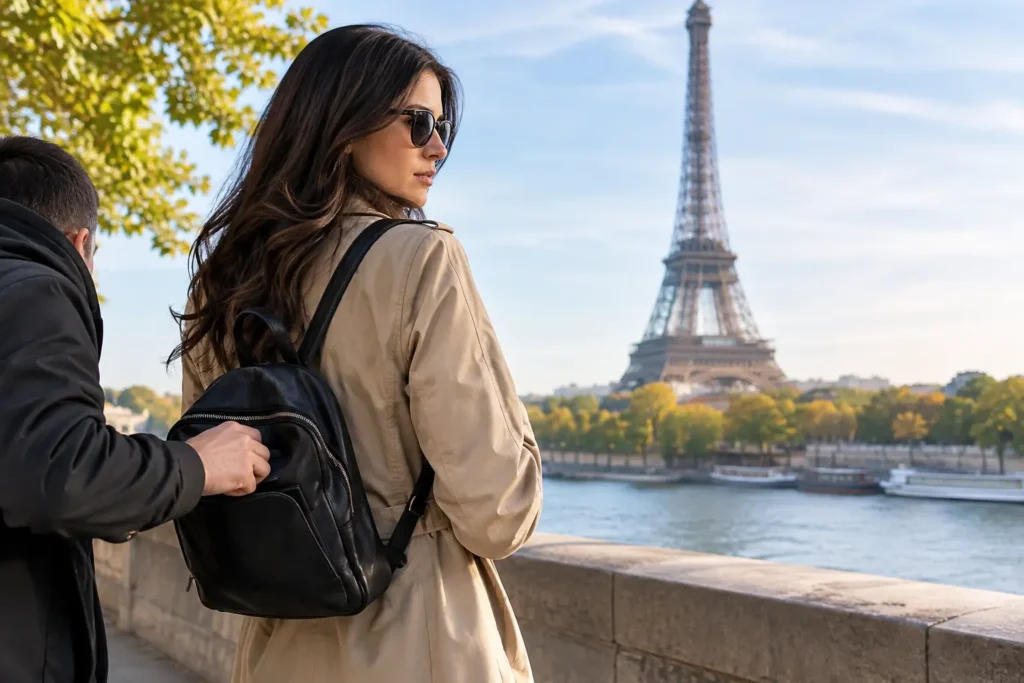
The most common moment is the squeeze: passengers step toward a Metro door, someone pauses unexpectedly, another person brushes past, and a hand reaches into an accessible pocket or bag. Keep your bag in front of your body before the train arrives, not after the doors open. If you are carrying a backpack, wear it on your chest in crowded stations and inside packed cars.
Do not assume a polished appearance means a person is trustworthy, or that a casually dressed person is not. Focus on behavior instead. Unwanted closeness, repeated attempts to start an urgent conversation, or someone reaching across your personal space are useful warning signs.
Phone and Wallet Carrying Habits
Your phone is often more valuable than the cash in your wallet because it holds bank apps, travel confirmations, maps, and personal accounts. Keep it in a zipped front pocket, an inside jacket pocket, or a crossbody bag worn across your chest with the zipper facing inward. A wrist strap can help while taking photos, but it is not a substitute for putting the phone away immediately afterward.
Avoid walking with your phone held at waist height while following directions. Stop with your back to a wall, doorway, or shop window, check the route, then put the phone away before moving on. Around the Eiffel Tower, Sacré-Cœur, the Louvre, Notre-Dame, and the Champs-Élysées, this small pause is far safer than navigating while distracted in the flow of pedestrians.
Carry one payment card and a limited amount of cash for the day. Leave backup cards, your passport, and most cash in your accommodation’s locked storage if it is available. If you must carry your passport, keep it separate from your everyday card and cash. Losing one item is inconvenient; losing every form of identification and payment at once can interrupt the trip.
A crossbody bag with a zipper is usually more practical than a large open tote. Keep the zipper closed even when the bag is under your hand. For families, distribute essentials between adults rather than placing every passport, card, and ticket in one bag.
Metro and RER Awareness
The Paris Metro is a useful, normal part of a visit. Use it, but prepare before you enter the station. Save your destination, know which line and direction you need, and have your ticket or phone ready before reaching the gate. Looking for a route is easiest beside the wall or away from the turnstiles.
On the platform, stand back from the edge and keep bags in front. When a train arrives, let passengers leave first. Do not force your way into a crowded car simply to save a few minutes. The next train is often close behind, and waiting can give you more room to keep track of children, bags, and pockets.
RER trains need the same care, especially on lines serving airports and large stations. At Gare du Nord, for example, follow signs slowly and confirm the train’s final destination on the platform display. If someone insists that your ticket is invalid, that a machine is broken, or that you must follow them to another area, decline and find a uniformed transport employee or an official information desk.
Metro service generally begins around 5:30 a.m. The last trains usually leave terminal stations around 1:15 a.m. Sunday through Thursday, with later departures around 2:15 a.m. on Friday and Saturday nights. Check the official RATP journey planner for the exact service on your date, particularly during engineering works or major events.
Distraction Scams Near Major Sights
A petition clipboard, a dropped ring, a bracelet tied onto your wrist, or a request to sign a form can be less about the conversation than about keeping your hands and attention occupied. You do not need to argue or explain. Say, “No, thank you,” keep walking, and keep your bag closed.
Be especially careful when someone says they found a ring and asks whether it is yours. Do not pick it up, inspect it, or continue the discussion. The same rule applies to people offering a “free” bracelet or souvenir, then demanding payment after it is in your hand.
Some visitors also meet people asking for money for a ticket, charity, or emergency. A real need may exist, but you are never obliged to hand over cash on the street. If you want to give, choose an established organization later, when you can make that decision without pressure.
Street sellers and photographers are not automatically a problem. The practical line is consent. If you did not request the service or product, do not accept it in your hands. Continue walking without engaging.
Cafés, Museums, and Hotel Lobbies
A relaxed setting can create a false sense of security. At cafés, keep your phone, wallet, and sunglasses off the table edge and out of reach of the chair beside you. Put your bag between your feet with a strap looped around a chair leg, or keep it on your lap in busier outdoor seating areas. Never hang it loosely on the back of a chair.
Museum security screening can also divide your attention. Put loose items into your bag before joining the line, rather than placing a phone, cardholder, and tickets separately into a tray. After screening, step aside and check that you have everything before walking toward the galleries.
In hotel lobbies and train-station cafés, do not leave luggage unattended while you order, use the restroom, or take a photo. Ask a travel companion to stay with it. Solo travelers are better off taking a small bag with them, even for a brief moment.
What to Do After a Theft
Act quickly, but do not chase someone or put yourself at risk. First, lock your bank card through your banking app or call the number on the card. Then use your device’s tracking and remote-lock feature if your phone is missing. Change the password for your primary email account early, because email access can be used to reset other accounts.
Report theft to the police if you need documentation for insurance, a replacement passport, or a phone claim. In France, call 17 for police, 18 for fire services, 15 for medical emergencies, and 112 for the Europe-wide emergency number. If you are in immediate danger or need urgent help, call rather than searching online for an office.
For a lost passport, contact your embassy or consulate as soon as possible and ask what documents are required for an emergency replacement. Keep a secure digital copy of your passport photo page, travel insurance details, and card issuer contact numbers before your trip. Store those copies somewhere separate from your phone, such as a protected email folder you can access from another device.
Frequently Asked Questions
Is Paris safe for first-time visitors?
Yes, but crowded transport and major visitor areas require the same awareness you would use in any large international city. Keep valuables secured, and you can explore central Paris comfortably.
Should I wear a money belt in Paris?
Yes, if it helps you keep a passport, backup card, and emergency cash separate from your daily wallet. Use it for items you do not need to access frequently, not for a phone you take out every few minutes.
Are backpacks safe on the Metro?
Yes, but wear them on your front in packed stations and train cars. A zipped backpack on your back is harder for you to see and easier for someone else to open.
Should I carry my passport every day?
No. Leave it in secure accommodation storage when possible and carry a photo or copy for routine sightseeing. Take the original only when an airline, official appointment, or accommodation requires it.
What should I do if someone offers me a free bracelet?
No. Do not accept it, do not let anyone tie it onto your wrist, and keep walking without a debate.
Can I use my phone for maps in public?
Yes, but check directions briefly from a stable position, then put the phone away before you walk. Avoid holding it loosely near Metro doors, curb edges, and crowded crossings.
Localada’s free Paris audio guide puts this in one place: every stop with opening hours, closing days and time to allow, plus walking routes, scam-awareness tips and verified local picks, narrated in 15 languages. Tickets booked through Localada’s GetYourGuide links are 5% off.
Sources and official information
Opening hours, prices and rules change. These are the primary sources behind this guide; check them before you go.
- Paris Police Prefecture: Staying safe in Paris (PDF): Police guidance for visitors on theft, scams and how to report them.
- UK Foreign Office travel advice: France safety and security: Government guidance on theft on the Paris Metro, RER and at major stations.
- RATP: tickets and fares: The Paris transport operator’s official ticket and fare information.
- UNESCO World Heritage Centre: Paris, Banks of the Seine: World Heritage listing for central Paris along the Seine.
- Musée du Louvre: hours and admission: Official opening hours, closing day and ticket rules.
Questions answered in this article
Summarise this guide with AI: ChatGPT · Claude · Perplexity