
















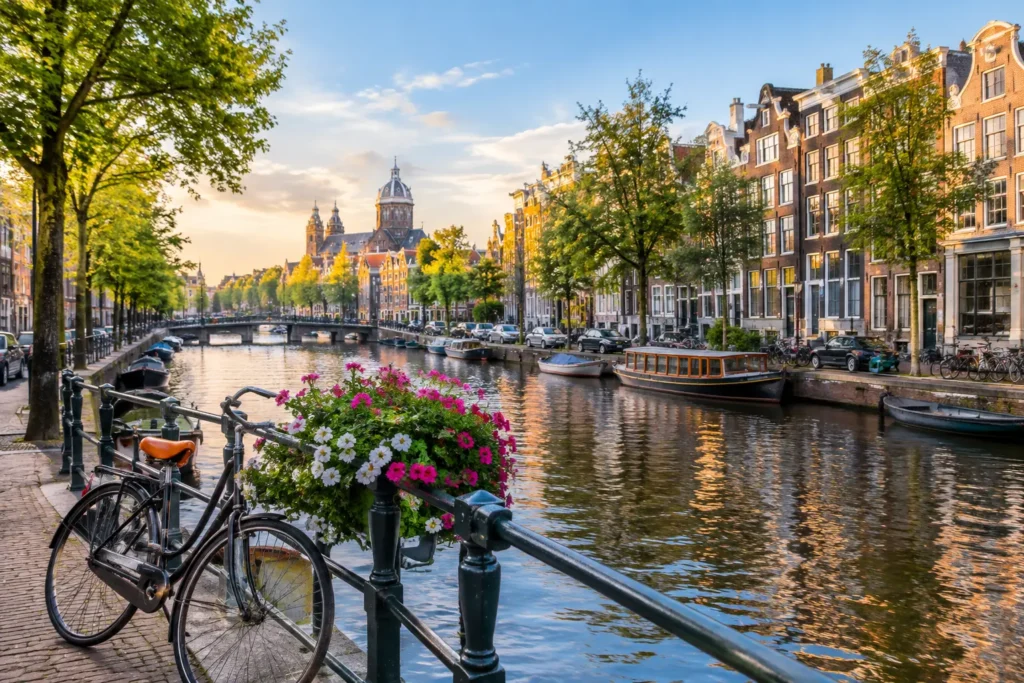
The Amsterdam canal ring walking route is best done as a 6 km loop from Amsterdam Centraal, following Brouwersgracht, Prinsengracht, Keizersgracht, Herengracht, and Singel. Allow three to four hours at an easy pace, or longer if you visit a museum, stop for lunch, or spend time photographing the bridges.
Essentials
- Walking time: 3 to 4 hours for the full 6 km route; 2 hours if you keep stops short.
- Hours and closed days: The canals and public streets are accessible every day, at all hours. Walk in daylight if this is your first visit so you can read street signs, see the house details, and avoid busy bike lanes more easily.
- Dress code: No dress code. Wear shoes with grip – cobbles, bridge slopes, and rain can make surfaces slick.
- Start and finish: Amsterdam Centraal station. Metro lines 51, 53, and 54 stop here. The first canal is about a 5-minute walk from the station entrance.
- Book ahead: Reserve Anne Frank House well in advance if you want to enter. It is on the route, but it is not a walk-in stop for most visitors.
Amsterdam Canal Ring Walking Route 2026
Where does the canal ring walk begin?
Start outside Amsterdam Centraal, then walk south along Prins Hendrikkade toward the first canal bridges. Turn right onto Brouwersgracht, one of the most rewarding stretches near the northern edge of the UNESCO-listed canal district. It has fewer major shops than the center, handsome former warehouses, houseboats, and open views toward the water.
Do not begin on Damrak unless you specifically want the busy souvenir-shop side of central Amsterdam. Brouwersgracht gives you the canal-ring experience sooner and with less crowd pressure. From Centraal, it is roughly 500 meters to the canal.
Which way should you walk around Amsterdam’s canals?
Walk west along Brouwersgracht until you reach Prinsengracht, then turn left and head south. This direction keeps the larger sights in a practical order and brings you back to the center without retracing the entire route.
Prinsengracht is the outermost of the three grand residential canals and the best place to understand how Amsterdam grew in the 17th century. The city’s merchants, craftspeople, churches, warehouses, and homes all occupied the same tightly planned landscape. Look upward as well as across the water: narrow facades, decorative gables, and pulley beams tell you as much as the canal itself.
Prinsengracht Landmarks
What can you see on Prinsengracht?
Your first worthwhile detour is Noordermarkt, just a few minutes south of Brouwersgracht. The square is especially lively on market days, but it is worth a look even when quiet. Continue south to the Westerkerk and the Anne Frank House area at Prinsengracht 263.
You can view the exterior and the nearby Westerkerk without a ticket, but be considerate here. The sidewalk can become congested, and the Anne Frank House is a place of remembrance, not a backdrop for posed photos. If you have a timed museum entry, arrive early enough to find the correct entrance and complete the security check.
From here, continue toward the Nine Streets, known locally as De Negen Straatjes. These small cross streets between the main canals have independent shops, cafes, and some of the most photographed canal corners. They are also narrow, so do not stop on bridge ramps or cycle lanes to take pictures.
Is the Anne Frank House part of the canal ring route?
Yes, but treat it as a separate timed visit rather than a casual stop. The museum sits directly on Prinsengracht and adds at least 75 to 90 minutes to your day once you include arrival, entry procedures, and the visit itself.
Check the Anne Frank House’s official website for current opening hours and ticket release details before building your route around it. If tickets are unavailable, continue along Prinsengracht and visit the exterior respectfully. The route still works very well without going inside.
Keizersgracht and Herengracht
Which canals have the most impressive houses?
After the Nine Streets, cross east to Keizersgracht, then continue toward Herengracht. These two canals hold many of the grandest merchant homes in the ring. Keizersgracht is wider and more residential in feel; Herengracht has some of the district’s most ornate facades.
For the Golden Bend, follow Herengracht south from the Leidsestraat area toward Vijzelstraat. This section, called the Gouden Bocht, was historically one of the most prestigious addresses in Amsterdam. You do not need a guide to appreciate the scale, but it helps to notice the differences between houses: some are restrained and narrow, others are broad, symmetrical, and built to display wealth.
This is a good section for a slower pace. The canal ring is not a checklist of monuments. Its value is in the urban design: water, bridges, trees, commerce, and homes still functioning together centuries after the canals were dug.
Can you cross the canals anywhere?
Mostly, yes. Bridges appear frequently, but do not assume every bridge offers the best crossing for your route. Use the major cross streets around Leidsestraat, Spiegelstraat, and Vijzelstraat when you need to move between canals. They are easier to navigate and have clearer street signs.
Keep right on narrow sidewalks, especially around bridge approaches. Amsterdam residents use bicycles for everyday travel, and bike lanes are not pedestrian waiting areas. If you hear a bell, step fully onto the sidewalk rather than backing into the road.
Singel and the Return to Centraal
Is the Flower Market worth adding to the walk?
It depends on your interests. The Bloemenmarkt on Singel is a convenient stop if you want bulbs, flower-related souvenirs, or a quick look at a long-running canal-side market. It is not the quietest or most local-feeling part of the route, and the souvenir selection can be repetitive.
If you buy bulbs, ask whether they are approved for transport to your destination and keep any required documentation. Avoid anyone pressuring you to buy immediately or claiming a special one-day deal. A legitimate shop will let you compare items and read the packaging.
From Singel, walk north past Spui and Torensluis, then continue toward the edge of the old center and Amsterdam Centraal. This final section is busier, but it shows the contrast between the canal belt and the commercial core. The total distance from Centraal and back is about 6 km, depending on bridge choices and detours.
Practical Walking Safety
Is Amsterdam’s canal ring safe to walk alone?
Yes, but use the same awareness you would in any busy city center. Keep your phone and wallet secured in crowded areas near Centraal, Dam Square, the Flower Market, and tram stops. Do not leave bags unattended at cafe tables, even for a moment.
The more immediate risk is traffic, not the canals. Watch for bicycles, trams, delivery scooters, and cars when crossing. At night, stay on well-lit streets, do not sit on canal edges after drinking, and use marked crossings where possible. For an emergency requiring police, fire, or ambulance services, call 112.
What should you avoid on a canal walk?
Avoid walking in bike lanes, leaning over low canal railings for photos, and following people who offer unofficial tours or heavily discounted attraction access. For museums and major sights, use the attraction’s official website or a trusted booking partner, not a street seller or a sign claiming that a venue is suddenly closed.
Also give the route enough time. Trying to cover the canal ring, Rijksmuseum, Van Gogh Museum, Anne Frank House, and a canal cruise in one afternoon usually turns a pleasant walk into a rushed series of queues. Choose one major indoor visit and let the canals be the main activity.
Frequently asked questions
Is 3 hours enough for the Amsterdam canal ring walking route?
Yes, but keep your stops short and do not add a museum visit. Three hours works well for the 6 km loop, photos, and a coffee break.
Can I start the route at the Anne Frank House?
Yes. Start at Prinsengracht 263 if you have a timed entry, then continue south through the Nine Streets and return north via Herengracht and Singel.
Is the canal ring walk suitable for children?
Yes, but keep children close near bridges, bike lanes, and canal edges. A shorter route from Brouwersgracht to the Nine Streets is easier for younger walkers.
Are the canals accessible at night?
Yes. Public streets remain open, but daylight is better for a first walk and for seeing architectural details clearly.
Do I need a canal cruise after this walk?
No. The walk gives you a close view of bridges, facades, and neighborhoods. A cruise is worthwhile only if you also want the perspective from the water.
Can I use a wheelchair or stroller on this route?
Yes, but expect uneven paving, narrow sidewalks, and sloped bridge crossings. Plan a slower pace and use major streets for easier canal crossings.
If you want this route, practical timing, cultural context, and scam-awareness tips in one place, Localada’s free Amsterdam audio guide can help you explore independently without spending your day comparing conflicting information.
Sources and official information
Opening hours, prices and rules change. These are the primary sources behind this guide; check them before you go.
- Istanbulkart (Istanbul Metropolitan Municipality): The official transport card used on Istanbul trams, metro, buses and ferries.
- UK Foreign Office travel advice: Turkey safety and security: Government guidance on crime, unofficial taxis and drink spiking in Turkey.
- UK Foreign Office travel advice: getting help in Turkey: Confirms 112 as the emergency number for ambulance, fire and police.
Questions answered in this article
- Where does the canal ring walk begin?
- Which way should you walk around Amsterdam’s canals?
- What can you see on Prinsengracht?
- Is the Anne Frank House part of the canal ring route?
- Which canals have the most impressive houses?
- Can you cross the canals anywhere?
- Is the Flower Market worth adding to the walk?
- Is Amsterdam’s canal ring safe to walk alone?
- What should you avoid on a canal walk?
- Is 3 hours enough for the Amsterdam canal ring walking route?
- Can I start the route at the Anne Frank House?
- Is the canal ring walk suitable for children?
- Are the canals accessible at night?
- Do I need a canal cruise after this walk?
- Can I use a wheelchair or stroller on this route?
Summarise this guide with AI: ChatGPT · Claude · Perplexity