
Hagia Sophia is not a museum stop you can rush between breakfast and the Blue Mosque. It is an active mosque, one of Istanbul’s most significant historic buildings, and a place where visitor rules can shift around prayer, security, restoration, and crowd levels. Knowing how to visit Hagia Sophia before you reach Sultanahmet Square will save you time, prevent an awkward entry mistake, and leave more room to appreciate what is in front of you.
How to Visit Hagia Sophia: Know Which Entrance Applies to You
For centuries, Hagia Sophia has changed roles while remaining at the center of Istanbul: Byzantine cathedral, Ottoman imperial mosque, museum, and now a functioning mosque again. That living status affects the visit. You are entering a religious space, not simply an attraction with a fixed museum routine.
Access for worshippers and international visitors may be organized separately. Foreign visitors are generally directed to the designated tourist entrance and paid visitor area, while worshippers use the prayer entrance. The visitor route has often focused on the upper gallery, where you can see the vast interior from above and view famous Byzantine mosaics. Do not assume you can enter through the first door you see or walk into the main prayer area as a tourist.
Ticket arrangements, visitor routes, restoration work, and opening hours can change. Check the current official notices on the day of your visit, especially if you are traveling during a major holiday, Ramadan, Friday prayers, or a busy summer weekend. If someone outside the site tells you it is closed and offers to take you somewhere else, do not follow them. Walk to the official entrance or ask uniformed site staff.
Choose Your Time Around Prayer and Crowds
The biggest practical issue is timing. Hagia Sophia closes to tourist visits during prayer periods, and the exact timing changes with the season. Friday is especially important because midday prayers draw larger local crowds. A Friday visit can still work, but it is less predictable than a morning on another day.
Arrive early, ideally shortly after the visitor entrance opens. You will usually face a shorter security line, have more space in the gallery, and get a calmer view across the central dome. Late afternoon can also be pleasant once large tour groups move on, but do not cut it too close to closing time. Entry can stop before the published closing hour.
Allow about 45 to 75 minutes inside if you want time to understand the building rather than take a few photos and leave. Add extra time during peak season for security and ticket lines. If Hagia Sophia is the first stop on your Old City day, follow it with the nearby Blue Mosque or Basilica Cistern. That keeps your route compact and avoids paying for taxis to cover distances you can walk in minutes.
Tickets, Audio Guides, and What You Are Paying For
Hagia Sophia’s ticket rules have been a source of confusion because the building’s religious and tourist functions operate differently. International visitors may need a ticket for the tourist section, even though the mosque itself is a place of worship. Buy only from the official ticket office, official digital channel, or a verified booking provider that clearly states what is included.
Before paying, check three details: which entrance you should use, whether an audio guide is included, and whether your booking is timed. A cheap-looking offer is not a good deal if it sends you to the wrong gate, excludes the guide you expected, or adds fees at checkout.
An audio guide is worthwhile here if you enjoy history. From the gallery, it can help you connect details that are easy to miss: the enormous dome, the marble revetments, Ottoman calligraphic roundels, imperial doors, and the mosaics that survived repeated changes in the building’s use. Without context, Hagia Sophia can feel overwhelming. With even a short explanation, you begin to see why its architecture influenced both churches and mosques across the region.
Avoid unofficial guides who approach you in the square with claims of “no line,” “special ticket,” or “only entrance.” Some may be legitimate guides, but pressure is a warning sign. A real service can explain its price, meeting point, inclusions, and cancellation terms without rushing you.
Dress and Behavior Inside the Mosque
Hagia Sophia welcomes visitors, but respectful dress is not optional. Shoulders and knees should be covered. Women should bring a head covering for the mosque area, and coverings may be available near the entrance when needed. Bring your own lightweight scarf if possible. It is simpler, cleaner, and useful for the Blue Mosque as well.
Shoes may need to be removed in designated prayer areas. Follow the signs and staff instructions rather than copying another visitor. Keep your phone on silent, speak quietly, and do not walk in front of people who are praying.
A few simple habits make the visit better for everyone:
- Wear clothing that covers shoulders and knees, and carry a scarf if you may need one.
- Keep photography discreet. Do not use flash, drones, tripods, or pose people who are worshipping.
- Stay behind barriers and follow the marked visitor path, particularly near fragile historic surfaces.
- Pause if a prayer call or service begins, and let worshippers move freely through their space.
The point is not to make visitors feel nervous. It is to recognize that Hagia Sophia is both a world landmark and a place of worship. Respectful behavior is the easiest way to keep that balance intact.
Get There Without the Sultanahmet Transport Traps
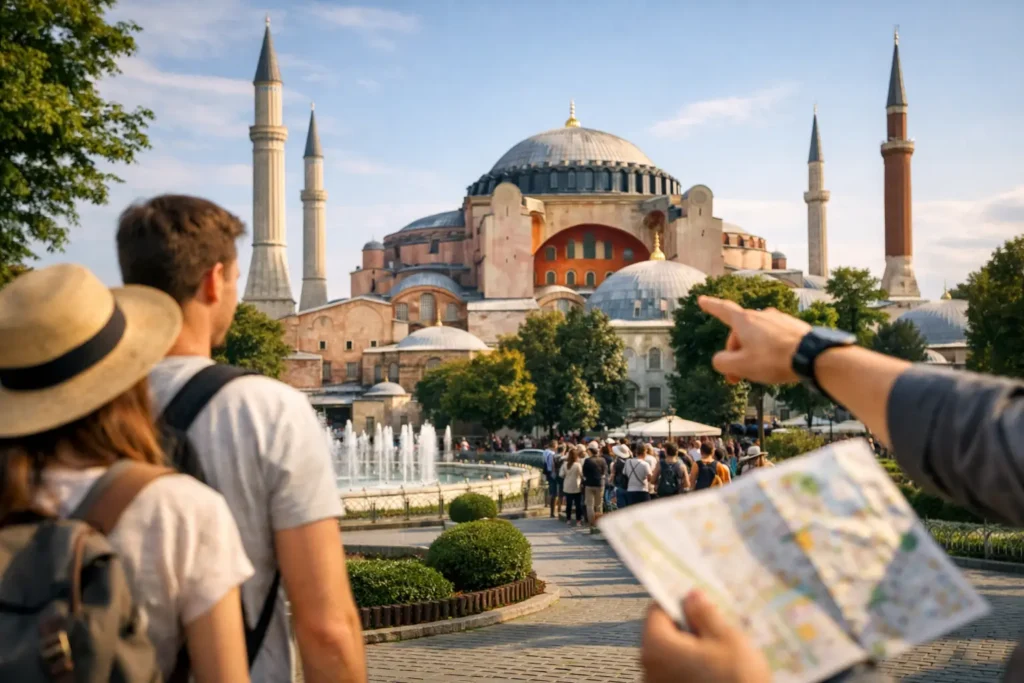
Hagia Sophia stands in Sultanahmet Square, directly opposite the Blue Mosque and close to Topkapi Palace, the Basilica Cistern, and the Istanbul Archaeological Museum. The T1 tram is often the simplest choice. Get off at Sultanahmet and walk a few minutes into the square.
If you take a taxi, use a metered, licensed vehicle and confirm that the driver starts the meter. Do not accept a vague fixed price from someone approaching you near a transit stop. The Old City is walkable, but its streets can be steep, uneven, and crowded. Give yourself extra time if you use a stroller, wheelchair, or have limited mobility.
Do not let a driver or street promoter redirect you to a carpet shop, leather store, or restaurant before your visit. A common line is that Hagia Sophia is “closed for an hour” or that the best entrance is in another direction. Unless official staff or posted notices confirm it, treat that as a sales tactic.
Build a Smart Old City Plan Around It
Hagia Sophia is best visited as part of a small, well-paced cluster rather than a race through every landmark. Start with Hagia Sophia early. Then choose one major indoor stop, such as the Basilica Cistern or Topkapi Palace, and one outdoor or religious stop, such as the Blue Mosque. This mix gives you variety and a backup if prayer times or queues change your plan.
For families, the upper gallery and long historical explanations may hold older children’s attention better than toddlers’. For solo travelers, morning is often the most comfortable time to navigate the entry process without crowd pressure. Couples may prefer late afternoon light in Sultanahmet Square, but should still leave a buffer before the last tourist admission.
Keep water, a light layer, and a charged phone with you. Public restrooms and places to sit are easier to find when you plan ahead than when you are already tired in a crowd. If you want a guide, choose one that is clear about the route, language, duration, group size, and total price. Localada’s Old City guidance can help travelers keep those details in one place rather than relying on whoever approaches them in the square.
Common Questions Before You Go
Is Hagia Sophia free to visit?
The answer depends on the section you are entering and the rules in effect on your travel date. Worshippers and tourists may use different access points, and international tourists may be charged for the designated visitor route. Confirm the current arrangement before going.
Can non-Muslims visit Hagia Sophia?
Yes. Non-Muslim visitors are welcome when tourist access is open, provided they follow the dress code, prayer-time restrictions, and visitor instructions.
Can I visit during prayer time?
Tourist access is usually paused during prayers. Instead of waiting at the gate, visit a nearby site, have tea, or walk through Sultanahmet Square, then return when visitor entry resumes.
Is the Blue Mosque a good alternative if Hagia Sophia is busy?
Yes, but it has similar prayer-time and dress expectations. The two sites are close enough that you can check the entry conditions at one, then walk to the other without losing much time.
Hagia Sophia rewards visitors who slow down just enough to notice the layers: Christian mosaics above, Ottoman calligraphy below, the sound of worship in a building that has witnessed almost 1,500 years of Istanbul. Arrive prepared, use the official route, and let the building set the pace.