

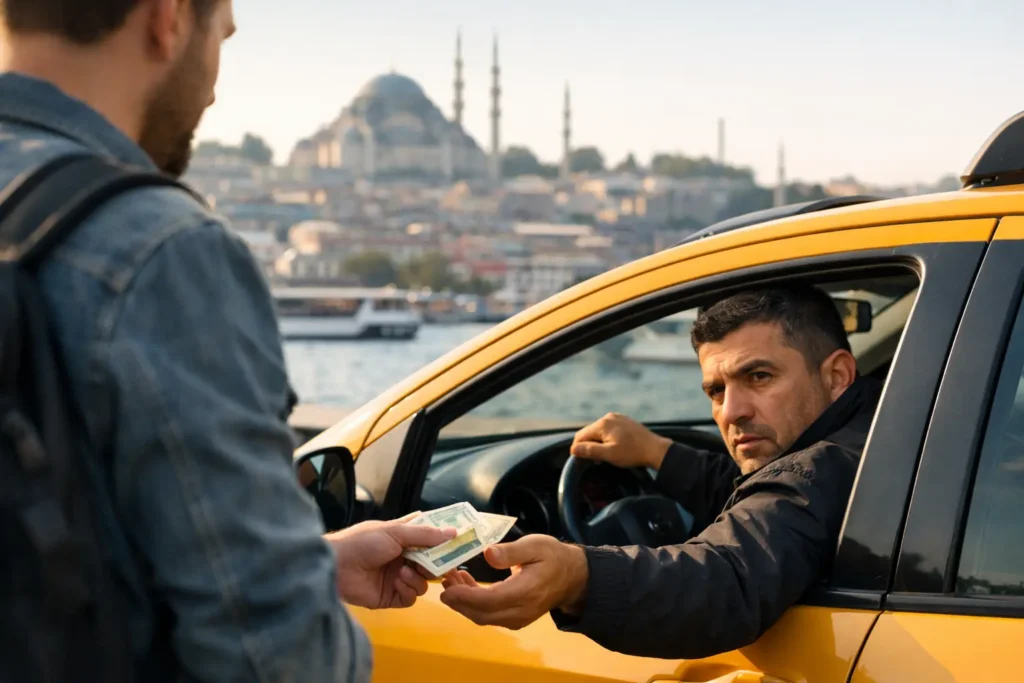
Most Istanbul taxi scams are avoidable: use an official taxi, make sure the meter starts, follow the route on your phone, and pay with small notes where possible. For Istanbul taxi scams how to avoid them, the goal is not to distrust every driver – it is to make a few calm checks before the car moves.
Taxi Essentials 2026
- Best alternative for short Old City trips: Walk when practical. Sultanahmet, the Grand Bazaar, Eminönü, and Sirkeci are often faster on foot or by tram than by car.
- Nearest public transit: T1 tram stops include Sultanahmet, Çemberlitaş, Beyazıt-Kapalıçarşı, Eminönü, and Sirkeci. A taxi is rarely necessary between these stops.
- Airport arrivals: Use the marked official taxi rank, or choose a scheduled airport bus or pre-arranged transfer. Do not accept a ride from someone approaching you inside the terminal.
- What to prepare: Keep your destination written in Turkish, turn on your map, and carry smaller Turkish lira notes.
- Emergency numbers: Dial 112 for emergency assistance. Police: 155. Fire: 110. Coast Guard: 158.
Istanbul is a large, busy city, and most taxi rides are ordinary. The problems travelers remember tend to happen when they are tired after a flight, do not know the route, or feel rushed to get into the first available car.
Official Taxis and Pickup Points
Use taxis from a hotel stand, a clearly marked taxi rank, or an established taxi app. At Istanbul Airport and Sabiha Gökçen Airport, follow airport signs to the official taxi queue rather than responding to anyone offering a ride in the arrivals hall.
An official Istanbul taxi should have a roof sign and a visible taximeter inside. Before you close the door, say your destination and point to it on your phone. This avoids the common problem of a driver claiming not to understand the address after the ride has started.
For a trip to Sultanahmet, give the hotel name or a recognizable landmark such as Sultanahmet Tram Stop rather than only a street address. Many Old City streets are narrow, one-way, or restricted at certain times, so a driver may need to stop a few minutes’ walk away. That is normal. Being dropped far from the area without a clear reason is not.
The Istanbul Metropolitan Municipality’s iTaksi service is one municipal option for requesting a car. It gives you a recorded pickup point and destination, which can reduce misunderstandings. If you prefer to hail a taxi, take a quick photo of the license plate before getting in.
Meter Use and Route Checks
The meter should be running shortly after the trip begins. Watch for it, but do not turn the moment into an argument. A simple, friendly “Meter, please” is enough if it has not been switched on.
Do not agree to a fixed fare for a normal city ride. A driver may offer one because it seems easier, especially if you have luggage or are headed to a tourist district. But a fixed amount removes the meter’s protection and gives you no simple way to judge whether the charge is reasonable.
Open your preferred map app before departure and compare the route as you travel. You do not need to police every turn. Istanbul traffic, one-way streets, bridge approaches, and roadwork can create legitimate detours. What matters is the overall direction. If the route is heading away from your destination for several minutes without explanation, ask calmly: “Is this the quickest route to Sultanahmet?”
A driver who claims that your hotel, the Blue Mosque, Hagia Sophia, or the Grand Bazaar is closed and suggests a different restaurant, leather shop, carpet store, or tour is not giving transport advice you need to follow. Thank them, stay with your original plan, and ask to be dropped at the destination you named.
Payment and Change Scams
The most common payment disputes happen at the end of a ride. The meter may be correct, but confusion over notes or change creates the problem.
If you are paying cash, say the value of the note as you hand it over and wait for your change before leaving the car. Keep smaller notes for short rides when possible. Do not hand over a large note while looking away for luggage, a phone, or children.
One tactic is a rapid note swap: the driver receives a higher-value note, then claims you gave a smaller one. Prevent this by holding the note where both of you can see it and saying its value aloud. Another is receiving change in a hurry and assuming it is correct. Count it before the door closes.
Card payment can be convenient, but confirm that the terminal shows the correct amount before tapping or entering a PIN. If a driver says the card machine is broken after the trip, you can pay cash if you have it, but do not let a supposed machine failure pressure you into accepting an unmetered amount.
Ask for a receipt if there is any disagreement. A legitimate driver should be able to provide one, and the taxi’s plate number is useful if you later need to report a concern.
Old City Traffic and Realistic Taxi Choices
A taxi is useful when you have heavy bags, are traveling with young children, are returning late to your accommodation, or are crossing longer distances between neighborhoods. It is less useful for short journeys within the historic peninsula.
From Sultanahmet to the Grand Bazaar is about 1 km, roughly 15 minutes on foot. Sultanahmet to Sirkeci is about 1.5 km, around 20 minutes walking downhill. Sultanahmet to Eminönü is about 2 km and usually takes 25 to 30 minutes on foot, depending on stops and crowds. The T1 tram connects these areas without the delays of road traffic.
Traffic around Sultanahmet can be especially slow in the morning and late afternoon. A taxi may be unable to enter the final streets near your hotel, while a tram stop is a straightforward walk away. Choosing transit is not only cheaper in many cases – it also removes the risk of a taxi dispute altogether.
For transport maps, route notices, and municipal services, use official Istanbul Metropolitan Municipality information. Keep in mind that road restrictions can change around major events, public holidays, and busy weekends.
Calm Responses to a Problem Ride
If something feels wrong, focus on getting out safely rather than winning an argument inside a moving car. Ask to stop at a busy, well-lit place such as a hotel entrance, tram stop, pharmacy, or café. Pay the metered amount if you can do so safely, take a photo of the plate if appropriate, and leave.
Do not hand over your passport, phone, or bank card to settle a dispute. Do not follow a driver to an ATM. If you are being pressured, call 112 or ask a nearby hotel employee, shopkeeper, or police officer for help. Istanbul’s main visitor areas are busy, and asking for assistance is normal.
If the issue is a suspected overcharge after you have left, save screenshots of your route, payment record, pickup location, and taxi plate. Those details matter far more than trying to remember the driver’s description later.
Frequently asked questions
Should I use a taxi from Istanbul Airport to Sultanahmet?
Yes, but use the official airport taxi rank, confirm the meter is on, and avoid unsolicited offers in arrivals. A scheduled transfer or airport bus can also be a calmer choice after a long flight.
Can I negotiate a taxi fare in Istanbul?
No. For a regular city taxi, ask for the meter rather than negotiating a fixed amount before departure.
Is it safe to take a taxi alone at night?
Yes, but choose an official taxi or app booking, share your route with someone if possible, and avoid getting into a car approached by an unlicensed driver.
What should I do if a driver says my hotel is closed?
No. Do not change your plans based only on the driver’s claim. Check with your hotel directly or continue to the address you entered in your map.
Should I pay cash or card in an Istanbul taxi?
It depends. Cash makes it easier to settle a short ride if you have small notes, while card payment gives you a transaction record. In either case, confirm the amount before payment.
How far is the Grand Bazaar from Sultanahmet by foot?
About 15 minutes. The distance is roughly 1 km, so walking is often easier than taking a taxi through Old City traffic.
If you want this guidance in one place while you explore, the Localada Istanbul Pack includes practical scam-awareness advice, walking routes, cultural audio stories, and vetted local recommendations for your group.