

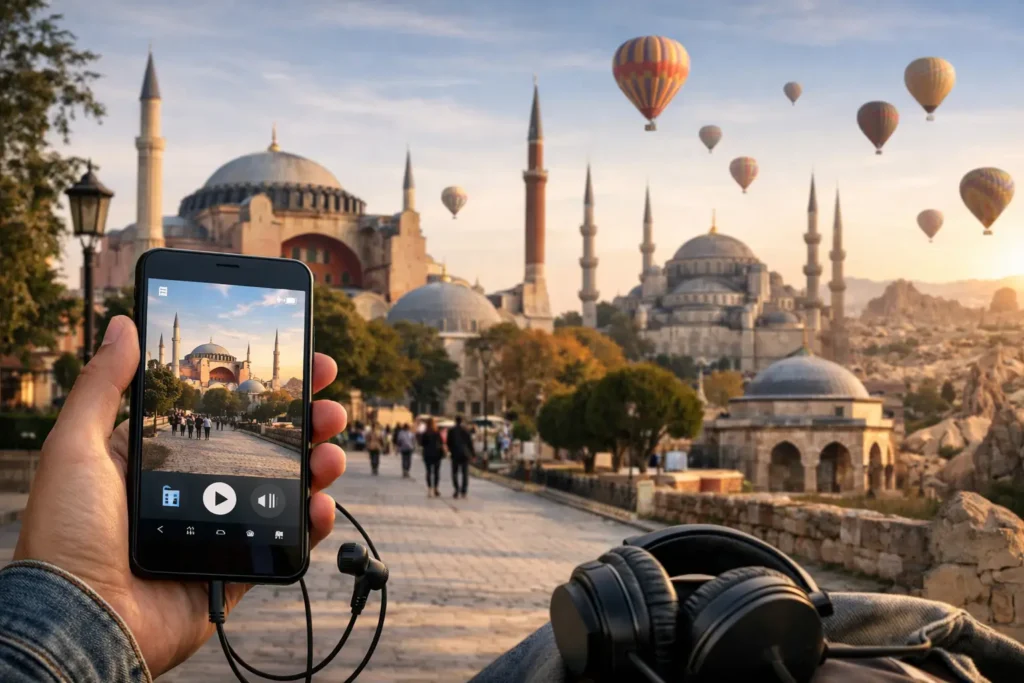
You are standing outside Hagia Sophia, the morning line is already forming, and a guide holding a raised flag is moving a group through the entrance. This is the moment an Istanbul audio guide app should make your day easier – not add another screen, another payment, or another confusing set of directions. The right one gives you the story behind what you are seeing, tells you what to do next, and leaves you free to explore at your own pace.
For independent travelers, that flexibility matters. Sultanahmet is compact enough to walk, but its landmarks carry layers of Byzantine, Ottoman, religious, political, and everyday history. A useful guide helps you make sense of those layers without turning a day out into a lecture.
What an Istanbul Audio Guide App Should Actually Do
The first job is simple: explain what is in front of you. At Hagia Sophia, that means more than naming the building and giving a date. Good narration helps you notice the scale of the dome, the changing purpose of the site, and the details visitors often pass without seeing. At the Blue Mosque, it should clarify visitor etiquette and point out the architectural choices that make the interior distinct.
The second job is navigation. An app can have excellent stories and still be frustrating if it leaves you wondering which entrance to use, whether a site is nearby, or how long the walk will take. Look for an interactive map that places stories in a sensible walking order. In the Old City, a route that moves naturally between Hagia Sophia, the Blue Mosque, the Hippodrome, Basilica Cistern, Topkapi Palace, and the Archaeological Museum saves more time than a long list of disconnected facts.
Finally, it should provide useful context around the visit. Attraction access rules, opening arrangements, prayer times, security procedures, and restoration work can change. An app should encourage you to confirm current entry details through official sources instead of presenting old information as certain. It should also be clear that audio guidance is separate from admission. You may still need to arrange entry through the official channel for attractions that charge admission.
Choose Audio That Fits Your Travel Style
Not every traveler wants the same kind of tour. Before downloading or buying anything, consider how you like to explore.
If you travel with children, short stories and clear map prompts are often better than hour-long lectures. Families tend to benefit from being able to pause for a snack, restroom break, or unexpected detour without losing the thread of the day.
Couples and solo travelers may prefer a more detailed route that leaves room for wandering. The best format lets you listen beside a landmark, then put your phone away and take in the atmosphere. Sultanahmet is not a place to experience entirely through headphones.
Language support is also more than a convenience. Historical sites can be difficult to follow when the narration uses unfamiliar architectural or religious vocabulary. Choose guidance available in the language you understand best, with plain explanations rather than translated text that feels stiff or overly academic.
Look for practical details, not just history
A city guide becomes more valuable when it handles the small decisions that interrupt a day. Can you find a clean route from the Basilica Cistern to the Grand Bazaar? Does it explain why a particular restaurant area is more tourist-focused? Does it help you distinguish a normal sales approach from pressure that should make you walk away?
That practical layer is especially useful around major attractions. Istanbul is welcoming and easy to enjoy when you use ordinary city awareness, but busy visitor areas attract a few predictable schemes. Be cautious if someone insists an attraction is closed and offers to take you to a different shop, tour, or entrance. Verify closures yourself. Likewise, do not let a stranger rush you into an unplanned carpet, jewelry, or perfume stop because they claim it is part of a tour.
A good audio guide does not make these situations sound scary. It simply gives you a calm response: thank the person, keep walking, and use official information for tickets and opening details.
Offline Access Is Worth Checking
Mobile service in central Istanbul is generally easy to find, but relying on it all day can still be inconvenient. Thick stone walls, crowded indoor spaces, low battery, and roaming costs can all get in the way. If an app offers downloadable audio and maps, download them over Wi-Fi before leaving your hotel.
Bring headphones, but keep one ear free while walking near traffic, tram tracks, and crowds. A small power bank is useful too. Navigation, photos, translation, and audio can drain a phone faster than expected on a full sightseeing day.
Offline access is particularly helpful inside large or underground spaces. The Basilica Cistern has a very different mood from the bright plazas outside, and it is much easier to appreciate when your guide continues to work without buffering. The same applies when you are moving through the busier passages of the Grand Bazaar, where it is easy to lose track of where you entered.
Be Honest About the Limits of an App
An audio guide is excellent for independent exploration, but it does not replace every kind of local expertise. If you have a deep interest in Ottoman art, Byzantine archaeology, or Islamic architecture, a licensed in-person guide may offer the chance to ask detailed questions and adjust the visit around your interests.
On the other hand, a private guide is not always necessary. For many first-time visitors, an audio guide is the better value because it lets the whole group move freely, pause when needed, and revisit stories later. The trade-off is that you will not have someone managing logistics for you in real time.
It also cannot solve a poorly planned day. Do not try to cover every major Old City attraction in a few rushed hours. Choose two or three priority sites, allow time for security lines and breaks, and treat the rest as optional. A guide should help you travel with more confidence, not convince you to check off landmarks faster.
Make the App Part of a Smarter Old City Day
Start early if Hagia Sophia, the Blue Mosque, or Topkapi Palace are priorities. Listen to the introduction before you arrive, rather than standing at the entrance trying to orient yourself while everyone around you is moving. Then use individual audio stops once you are inside or standing in front of a landmark.
Plan your route around geography. The Hippodrome sits naturally between Hagia Sophia and the Blue Mosque. The Basilica Cistern is nearby, while Topkapi Palace and the Archaeological Museum make sense together because they are close to one another. The Grand Bazaar is best treated as its own stop rather than something to squeeze in when you are already tired.
When shopping, keep the app in your pocket and stay present. Browsing is part of the experience, and bargaining can be friendly, but you are never required to buy because someone has offered tea, spent time showing you items, or quoted a special price. Ask the full price before agreeing, compare calmly, and leave if the interaction becomes uncomfortable.
The same principle applies to transportation after a long day. Use clearly identified taxi options, make sure the meter is used where applicable, or choose public transport when it suits your route. An audio guide is most helpful when it supports good decisions before small travel hassles become expensive or stressful.
The Best Value Is Guidance You Will Reuse
A free app may be enough if you only want a few basic facts. But if it is filled with ads, requires constant data, or gives you no help with routes and common visitor traps, it can cost you time instead. A paid option can make sense when it offers clear multilingual narration, route planning, and practical advice that a whole group can use.
Check how long access lasts before you buy. Istanbul rewards a slower visit, and it is useful to replay a story in the evening or return to a site the following morning. Also check whether the content is focused on the places you will actually visit. A huge catalog is not automatically better than a well-organized Old City guide.
If you want this guidance in one place, the Localada Pack combines narrated Old City stories, walking routes, multilingual support, practical scam-awareness tips, and vetted local recommendations for your group to use at its own pace.