
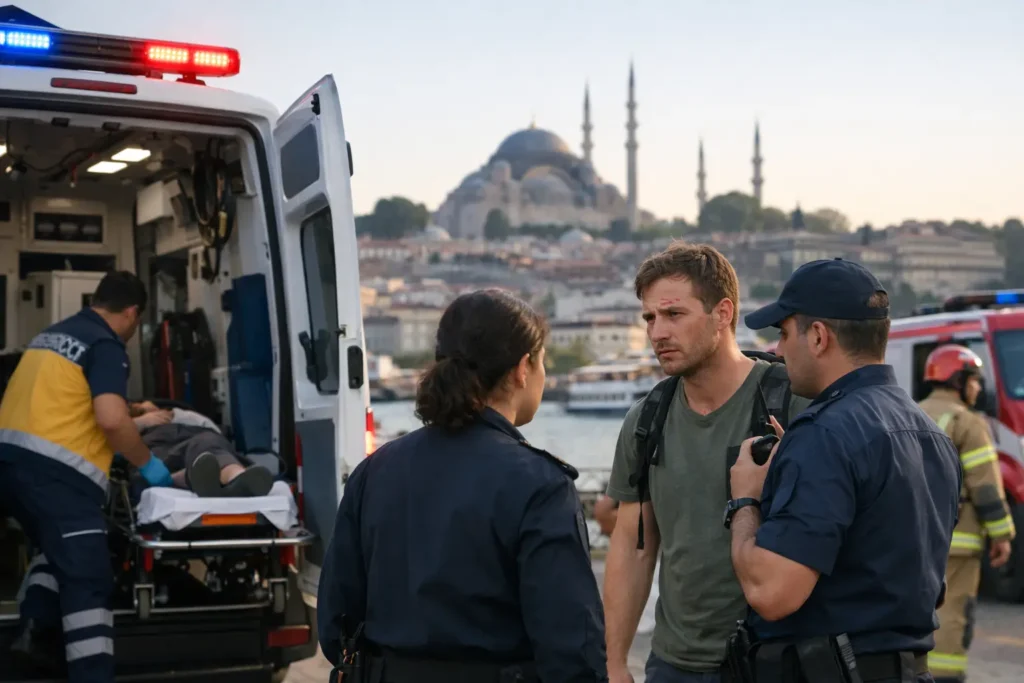
To handle Istanbul travel emergencies, call 112 for immediate danger or medical help, then protect your documents, payment cards, and location details before dealing with anything else. Most problems are manageable when you act in that order: get safe, contact the right service, and keep written records.
Essentials for Istanbul Emergencies
- Time to read: About 8 minutes. Save the emergency numbers in your phone before you leave your hotel.
- Emergency services: Call 112 for ambulance, police coordination, fire, or urgent assistance. Direct legacy numbers are police 155, fire 110, gendarmerie 156, and coastguard 158.
- Old City access: In Sultanahmet, the T1 tram serves Sultanahmet stop. Hagia Sophia, the Blue Mosque, the Basilica Cistern, and the Hippodrome are within a 2-8 minute walk. The closest metro connection is Vezneciler on M2, about 1.5 km or a 20-minute walk from Sultanahmet.
- Dress code: For a mosque, cover shoulders and knees; women should cover their hair. Keep a light scarf in your day bag. This matters if you need to enter or wait near a religious site.
- Friday access: Mosque visitor entry pauses during prayer periods, with the longest interruption around Friday midday prayer. The exact time changes daily, so use the posted prayer schedule at the entrance.
- Booking ahead: You do not need to book emergency services. Keep your travel insurance details, accommodation address, and passport photo stored offline.
Emergency Calls and Immediate Safety in 2026
Call 112 if you need an ambulance, are threatened, witness a serious accident, or cannot safely leave a situation. Say your location first. In the Old City, use a clear landmark such as “Sultanahmet tram stop,” “outside the Basilica Cistern,” or “Gate of Salutation at Topkapi Palace,” then give the nearest street name if you can see it.
Do not spend ten minutes trying to explain every detail. A simple message works: “Medical emergency. Adult injured. I am at Sultanahmet tram stop.” If you are traveling with someone, one person should stay with the injured traveler while the other speaks to staff, police, or emergency dispatch.
For a non-urgent city-service issue, such as a municipal concern, Istanbul’s White Table line is 153. It is not a replacement for 112. If you feel unsafe, are being followed, or face aggressive behavior, walk into a hotel lobby, museum entrance, pharmacy, restaurant, or tram station rather than continuing down a quiet street alone.
Medical Care and Pharmacies
For chest pain, breathing difficulty, severe bleeding, loss of consciousness, a serious fall, or a possible allergic reaction, call 112 immediately. Do not attempt to get across the city in a taxi when an ambulance is appropriate.
For less urgent needs, a pharmacy is called an eczane. Pharmacists can help with common minor problems and direct you toward a clinic or hospital. Outside regular pharmacy hours, look for “nöbetçi eczane,” meaning the duty pharmacy open overnight or on a holiday. A hotel reception desk can also identify the nearest one.
Bring your passport or a clear photo of it, your insurance information, and a list of medications or allergies. If a doctor recommends treatment, ask for written records, prescriptions, and receipts before you leave. They matter for an insurance claim later. If language is a concern, use short sentences and a translation app, but never delay urgent treatment while trying to translate perfectly.
Lost Passports and Stolen Belongings
A missing passport is stressful, but it does not mean your trip is over. First retrace your last two or three stops. In Sultanahmet, that may be a tram, a restaurant, a museum security check, or your hotel. Call the property directly or return in person during opening hours. Leave a local phone number or hotel name so staff can reach you.
If it is stolen, or you cannot locate it quickly, report the loss to police and ask for a written report or report reference. Then contact your embassy or consulate for an emergency travel document. Your embassy will normally tell you what identification, photographs, police paperwork, and travel proof it needs.
A phone photo of your passport, visa or entry record, insurance certificate, and onward flight details can save hours. Store these in a password-protected account and keep a second copy with a traveling companion if possible. Do not carry every card, all cash, and your passport in the same bag.
For a stolen phone, use another device to lock it remotely, change the passwords for your email and banking apps, and contact your mobile provider. Your email account comes first because it can reset almost every other password. If you use an eSIM, ask your provider how to suspend service without losing your number.
Card Problems and Cash Pressure
If your bank card disappears or shows a transaction you do not recognize, lock it in your banking app or call the number on the back of a different card. Keep the time, business name, and amount shown in your alert for your bank, but do not confront a shopkeeper based only on a delayed or unclear notification.
Avoid changing money with strangers in the street, even if the offer sounds helpful. Use a bank, established exchange office, or ATM in a busy, well-lit location. Before leaving an ATM, put away your cash and card rather than sorting receipts on the sidewalk.
If an ATM keeps your card, do not accept help from anyone standing nearby. Make a note of the bank name and ATM location, lock the card, and contact your bank. In most travel situations, replacing access to funds is more urgent than recovering that particular physical card.
Taxi Disputes and Transport Disruptions
A taxi disagreement is rarely a police emergency. If the driver refuses to use the meter, pressures you to change your destination, or demands extra cash, ask to stop in a busy public place. Photograph the license plate only if you can do so safely, pay only what you clearly agreed to or what appears on the meter, and leave the vehicle.
Do not get into a car with someone who approaches you inside or just outside a major attraction claiming that regular taxis are unavailable. Use an official taxi line, ask your accommodation to arrange a car, or take public transport when it is operating. The T1 tram connects Sultanahmet with Eminönü, Karaköy, Kabataş, and transfer points for other parts of the city.
If you leave an item in a taxi, write down the plate number, time, route, and any receipt details immediately. Your hotel can help you explain the situation in Turkish. If you have no plate number, give the pickup point and approximate time, but be realistic: recovery is less certain without identifying details.
Crowds, Scams, and Personal Security
Istanbul is welcoming and busy, especially around Sultanahmet, the Grand Bazaar, and the tram corridor. The practical risk is distraction. Keep your phone and wallet in a zipped front pocket, crossbody bag worn in front, or an inside jacket pocket. In crowded areas, do not hang a bag from the back of a chair or place it on a stroller without securing it.
Be cautious when a stranger creates urgency: a supposedly closed attraction that requires a private alternative, a friendly person insisting on a bar or restaurant, or an unexpected “free” service that changes into a demand for payment. A real emergency worker will not need your bank card, phone passcode, or passport as a deposit.
If you think you are being overcharged or pressured, step away. You do not need to win an argument to protect yourself. Go to a nearby hotel, official ticket office, museum entrance, or restaurant with staff and reset your plan from there.
Earthquake Procedures and Severe Weather
If an earthquake begins while you are indoors, drop low, take cover under sturdy furniture if available, and hold on. Stay away from windows, mirrors, shelves, and exterior walls. Do not use elevators. When shaking stops, follow staff instructions and leave carefully if the building is being evacuated.
Outside, move away from building facades, signs, utility lines, and walls. In the narrow streets around the Old City, resist the urge to run through traffic. Find an open area when it is safe to do so, keep your group together, and use texts rather than repeated calls to reduce pressure on mobile networks.
For heavy rain, use the same basic principle: avoid low underpasses and flooded streets, and do not force a route when tram or road conditions are disrupted. Ask your hotel for the safest current route rather than relying on an old map screenshot.
Frequently Asked Questions
Should I call 112 for a stolen wallet?
Only if the theft involves immediate danger, violence, or you cannot get to safety. Otherwise, cancel cards first, report the theft to police, and contact your embassy if your passport was inside.
Can I get medical help without speaking Turkish?
Yes, but bring your passport, insurance details, medication list, and use simple translated phrases if needed. For a serious emergency, call 112 rather than searching for a clinic yourself.
What should I do if a taxi driver will not use the meter?
Leave at a busy, safe place if you can do so calmly. Note the plate number and do not hand over your phone, passport, or bank card to resolve a fare dispute.
Is it safe to walk back to my hotel in Sultanahmet at night?
Usually, yes, on active, well-lit routes, but use normal city precautions. Keep valuables out of sight, avoid isolated shortcuts, and enter a hotel or restaurant if someone makes you uncomfortable.
Can my embassy replace a lost passport the same day?
It depends on your nationality, the embassy’s hours, your documents, and whether you need an emergency travel document. File a police report and contact the embassy as soon as possible.
What if I lose my phone and all my reservations are in it?
First, lock the phone remotely and secure your email and banking accounts. Then ask your hotel to help access reservation emails from another device and contact your carrier about your number.
If you want this guidance in one place while you explore, the Localada Istanbul Pack brings practical Old City safety advice, walking routes, cultural context, and vetted local recommendations together for your group.