

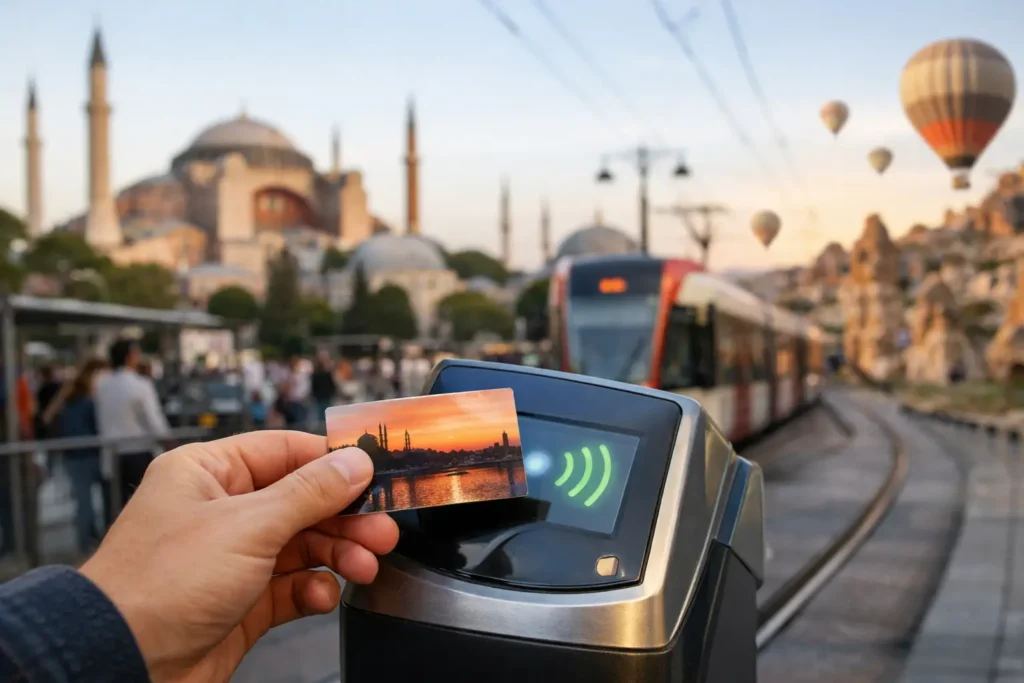
The first time you step into an Istanbul tram station, the system can look more complicated than it is: gates, ticket machines, people moving quickly, and signs in several directions. The good news is that to use Istanbulkart for tourists, you only need one habit: keep a funded card ready before you reach the gate. It is the practical key to getting around independently without negotiating taxi fares for every short journey.
Istanbulkart is Istanbul’s reusable public transportation card. You tap it at the reader to enter most city-run transport, including trams, metro lines, ferries, buses, funiculars, and the Marmaray rail service. It is especially useful for visitors staying around Sultanahmet, where the T1 tram connects many major stops and makes walking-heavy sightseeing days much easier.
Why Istanbulkart is worth using
A card is usually simpler than buying separate rides, and it gives you access to the routes travelers use most often. From Sultanahmet, you can take the tram toward Eminönü and Karaköy, use ferries for the Asian side, or connect to metro lines for other parts of the city. You do not need to understand the whole network on day one. You just need a card with enough balance and a map app to confirm your direction.
It also reduces one common travel friction point: paying for transportation. On a crowded tram or ferry terminal, nobody has time to stop and explain a route in detail. With Istanbulkart, you tap through the gate and keep moving.
For many visitors, the alternative is relying on taxis for every trip. Taxis can be useful late at night, when carrying luggage, or when public transit does not suit your route. But for short daytime trips between the Old City, Eminönü, Galata, and Kadıköy, public transportation is often more predictable. It also lets you see the city as residents do – on the water, along the historic peninsula, and through neighborhoods you would miss from a car.
Where to buy an Istanbulkart
Look for official Istanbulkart vending machines at major transport hubs. You will commonly find them at airport transit areas, large metro stations, ferry terminals, and busy tram stops. The machines are usually easy to recognize, but do not buy a card from someone approaching you outside the station or offering to “help” for an extra fee.
Choose a standard physical card if you are a visitor. Follow the machine instructions, pay the listed card deposit and initial balance, then keep the card for the rest of your stay. Machine payment options can vary by location, so carrying some Turkish lira cash is sensible, even if you expect to use cards elsewhere.
Before leaving the machine, check that you have received both the card and any change. Then load a little more balance than you think you need for the day. You can top up later, but it is frustrating to discover a low balance when a tram is arriving and a line has formed behind you.
One card or one per person?
One Istanbulkart can often be shared by a couple, family, or group traveling together, because each person can tap separately at the same gate. That can be convenient for occasional rides. Still, separate cards may make more sense if your group plans to split up, travels at different speeds, or wants to avoid passing one card back and forth during rush hour.
There can also be fare rules around transfers and discounts that differ by card type and current policy. Do not base your plans on a promised transfer discount. Treat any savings as a bonus, and make sure the card has enough balance for each person’s next ride.
How to use Istanbulkart for tourists at gates and vehicles
At a tram, metro, funicular, or Marmaray station, hold the card against the contactless reader at the turnstile. Wait for the screen and sound that confirm your tap, then go through. Do not rush in behind another passenger without tapping. That is not how the system works, and station staff may ask to see valid payment.
On buses, tap as you board. On ferries, tap at the entrance gates before walking to the dock. The process is the same across much of the network, which is why Istanbulkart becomes easier after your first few rides.
A few practical habits prevent most mistakes:
- Keep the card in an easy-to-reach pocket, not at the bottom of a bag.
- Tap once and wait for confirmation. Repeated tapping can be confusing when gates are busy.
- Check your remaining balance after a ride whenever the reader displays it.
- Top up at a station before an early airport trip, evening ferry, or long day outside the Old City.
If a gate does not open, first look at the display. Low balance is the most likely issue. Step aside rather than blocking the entrance, top up at the nearest machine, and try again. If the screen is unclear or the machine keeps your cash without loading the card, speak to staff at the station booth if one is available and keep any receipt.
The routes visitors actually use most
You do not need to memorize line colors to use Istanbulkart well. Start with the journeys that fit a typical Istanbul itinerary.
The T1 tram is the workhorse for many Old City stays. Stops around Sultanahmet, Gülhane, Eminönü, and Beyazıt connect you with major sights and walking areas. If your hotel is near Sultanahmet, the tram can save your legs after visiting Hagia Sophia, the Blue Mosque, Topkapı Palace, or the Grand Bazaar.
Ferries are more than transportation. A short crossing can be one of the best-value views in the city, with the skyline, mosques, bridges, and Bosphorus all around you. Use a ferry when you want to visit Kadıköy or Üsküdar, or simply when the route makes more sense than going underground. Check the departure board rather than assuming every dock goes to your destination.
The funicular connections near Kabataş and Karaköy can help when you are moving between the waterfront and uphill districts. They are particularly welcome after a long day, but they can get crowded at commuter times. If you have mobility concerns, avoid assuming every station entrance is step-free. Check the route and station layout before you set out.
Top-ups, balance, and real-world costs
Transit fares, card deposits, and payment rules can change. Use the official machine display for the current amount rather than relying on an old blog post or a screenshot from social media. The card balance is not a fixed daily pass, so you pay as you travel and refill when needed.
For a short Old City visit, you may use fewer rides than expected because Sultanahmet’s main attractions are close together. For a longer stay involving ferry trips, neighborhood meals, and airport connections, you will use the card much more. Load modestly at first, then add credit as you learn your rhythm.
Do not expect a cash refund for every unused balance when you leave. If you are traveling with companions, consider using the remaining credit for your final rides rather than overloading several cards near the end of the trip.
Avoid the mistakes that cost time
The most common Istanbulkart problem is not a scam. It is simply arriving at the gate with no balance and discovering that the nearest machine has a queue. Top up before you need to travel, especially when heading to the airport or catching a ferry with a timetable.
Be cautious around unofficial “helpers” at machines. Most people offering directions are genuinely trying to help, but you do not need to hand your card, cash, or bank card to a stranger. Use the machine yourself, ask uniformed station staff when available, or take a moment to translate the screen. Türkiye is welcoming to visitors, and a calm pause is usually safer than a rushed decision.
Also, do not confuse Istanbulkart with museum entry. It is a transportation card, not an attraction ticket. For sites such as the Basilica Cistern or Topkapı Palace, check official ticket information before your visit. Buying from an unauthorized street reseller can mean paying more than necessary or receiving misleading information about closures and queues.
When a taxi may still be the better choice
Istanbulkart is useful, not magical. A taxi can be more practical if you land late, are traveling with young children and luggage, have limited mobility, or are heading somewhere with awkward transfers. In that case, use a licensed taxi, ask for the meter to be used, and follow your route on your phone. For short central journeys during heavy traffic, though, the tram or ferry can be faster and less stressful.
If you want transit guidance, verified local recommendations, and practical scam-awareness advice in one place while exploring the Old City, the Localada Istanbul Pack is designed for independent travelers who prefer to move with confidence.